
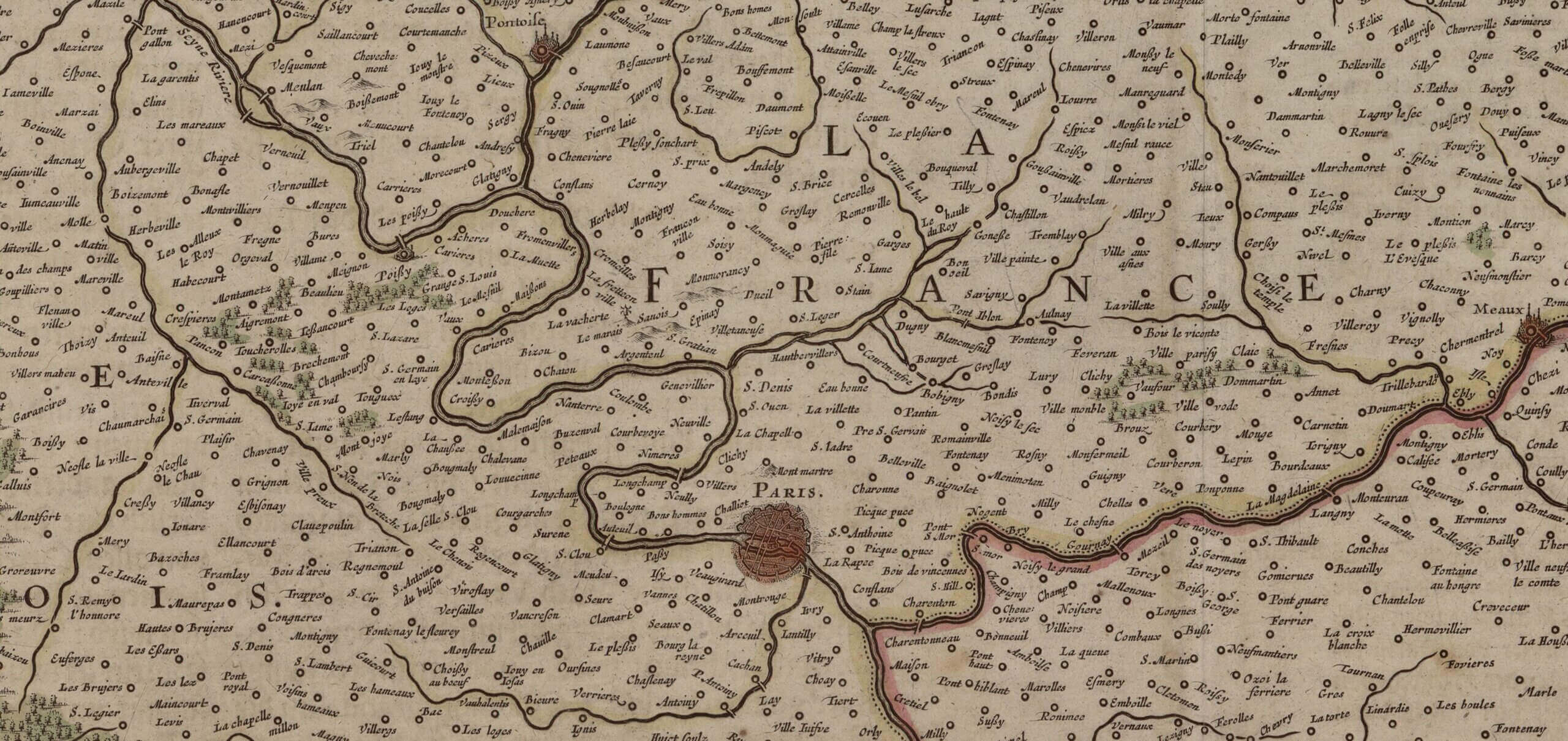
This article is the first in a series on How to Locate Your Ancestors in France, where we will explore the traps that come into play when tracing your origins.
Have you found records for your French ancestor in the country where your family settled, only to realize their birthplace or residence completely unreadable? Whether the location was misheard, written phonetically, transcribed in difficult handwriting, or altered during digital indexing, a misspelled place name, can really stall your research for years.
When a French place name is misspelled in a census, death certificate, obituary or newspaper article, there are several strategies you can use. For simple cases you can try a search engine or an AI assistant to suggest candidate places. You can also use a surname map to narrow down the region. If these do not help, the reliable method is to build the case around the person: name, birth date, places of residence, and every other document or relative you can find.
Why might a French place name be misspelled in a record?
In my work with French emigrant families, misspelled place names are one of the most common problems I meet. If you are familiar with France, some misspellings are easy to recognize. If you aren’t, those same distortions can quickly become insurmountable brick walls. Errors usually occur at three distinct stages: when the name is known, when it is written down, and when it is read today. And errors compound at every stage: a location misheard by a 19th-century clerk can easily be misread again by a 21st-century indexer. Each step creates another opportunity to misinterpret an unfamiliar name, especially when dealing with difficult handwriting.
Your ancestor pronounced or wrote it in their own way
Was my grandfather part of that illiterate minority? Not quite: he could write, but he grew up in the countryside with limited schooling. Look at this postcard he sent to his future wife in 1934
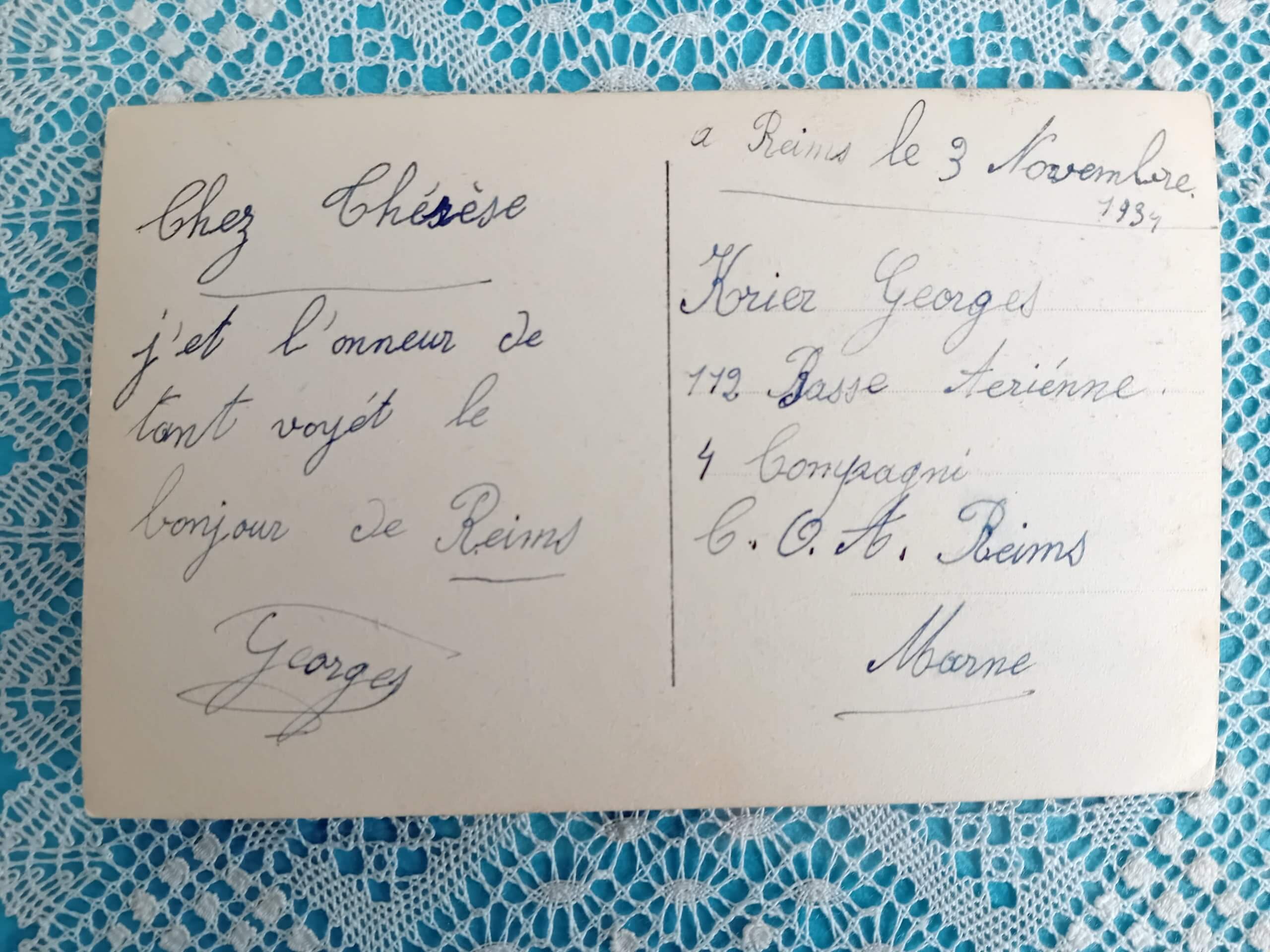
Many people knew their birthplace only by ear. An emigrant who left as a teenager may never have seen it or written it.
Accent and dialect matter too. An interesting example is “Toulon”, on the Mediterranean coast near Marseille, which I found written as “Tulong.” In southern France the name is indeed pronounced “Toulong,” with a nasal ending that sounds like a “g,”.
The recorder was unfamiliar with French spelling
It should come as no surprise that a clerk in Manchester, Seattle, Calgary or Canberra would probably be unfamiliar with French geography and spelling rules. Whatever name your ancestor provided, the clerk may have written what they believed they heard, or what they believed they saw when copying from a French document. I have met my fair share of unusual spellings: Bordeaux turned into “Bordax” and Roissy into “Roicy” and so on…
Even when the spelling was correct, the writing may not be. Ink fades, pages get stained or torn, and some clerks wrote quickly and carelessly. A name you have never seen is the hardest to read, because you cannot rely on the context to guess it. Letters such as u, n, m and i look alike in many hands, and a capital letter can be so ornate that it is unrecognizable.
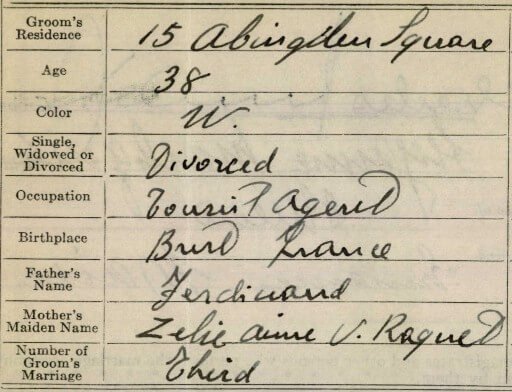
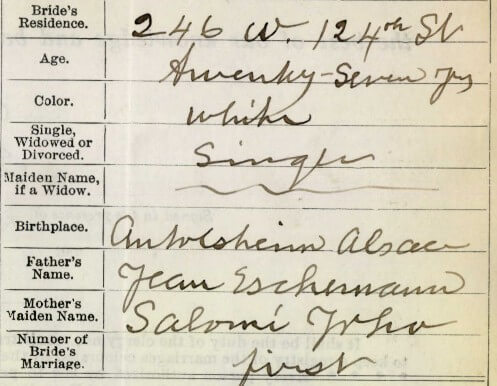
Online indexing added another layer of errors
Having indexed English-language documents myself, I know how hard it is to decipher a place name you have never seen. This is why the original image always matters more than the index.
Strategies to Find the Correct French Location
Test Search Engines and AI Tools
For minor phonetic errors, entering what you can read into a search engine often yields surprisingly quick answers.
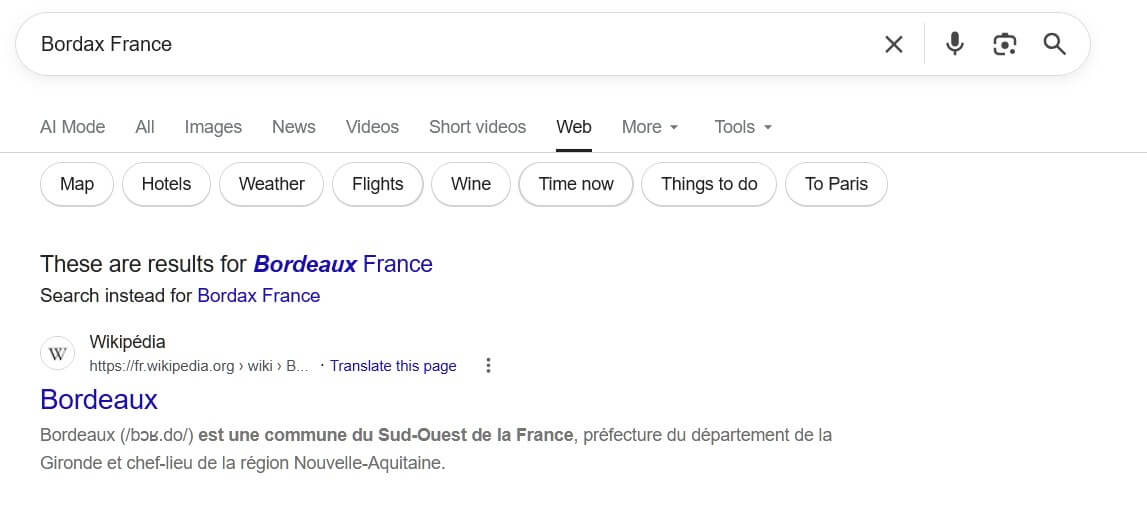
Searching for “Bordax, France” points toward “Bordeaux”.
Searching for “Tulong, France” likewise leads to “Toulon”.
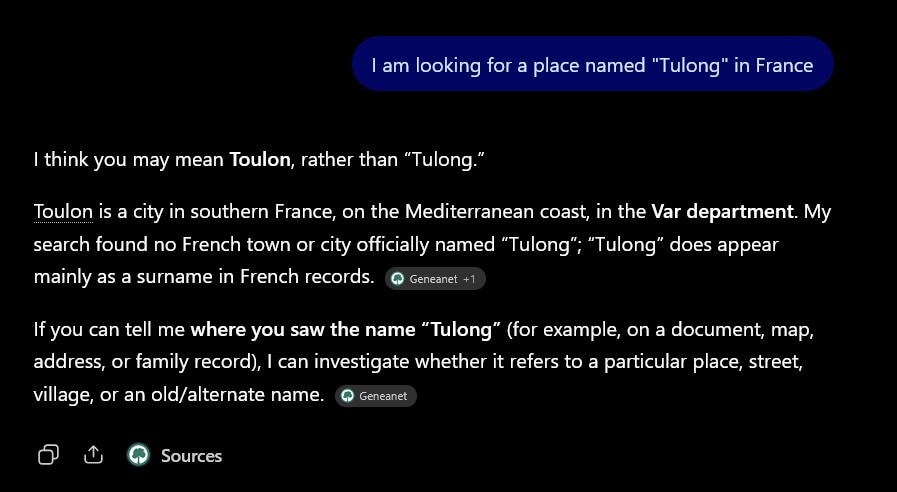
Uploading an image of a document to an AI assistant can also generate candidate locations.
These tools are less effective when the spelling bears little resemblance to the original, but it takes very little effort to try. Exercise caution: handwriting interpretation remains hit-or-miss. Treat these tools as sources for initial hypotheses, not direct proof.
Use a surname map to narrow the region.
Tools like Geneanet offer free surname distribution maps that show where specific family names historically concentrated in France (according to their database which is voluminous enough to be trustforthy), and how that changed over time.
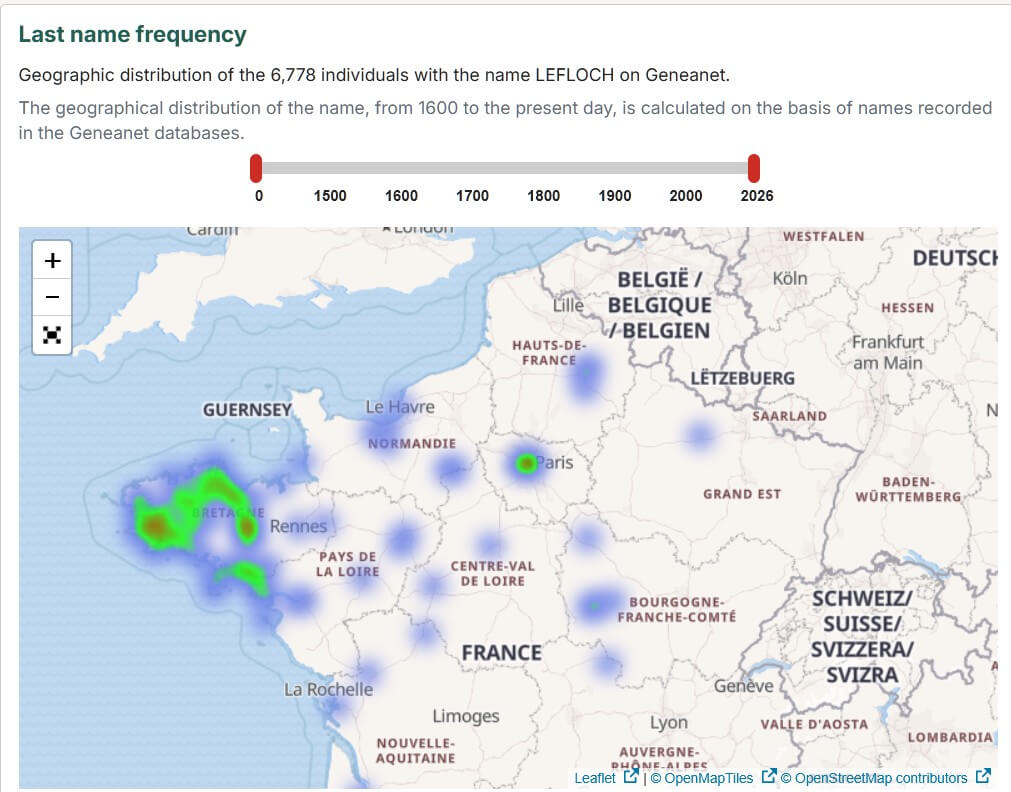
If several records point to a specific region and the surname is concentrated in a few communes there, start with those.
This method works best for distinct regional names. Common surnames like Martin, Bernard, Petit, or Moreau are distributed across the entire country.
Start with the person, not the place
When the place name itself is completely distorted, turn your focus back to the individual:
- Compare multiple records: Track the person across every available census, passenger list, naturalization file, or death record. Each document offers a fresh attempt by a different recorder.
- Research collateral relatives: Spouses, siblings, in-laws, or fellow witnesses from the same area may have left records with clearer spellings. Emigrants frequently traveled, settled, and married within communities from their home region.
Case Study: From a “Southern France” Scribble to Burgundy
This person-centered approach proved decisive in a case I researched for a British family tracing an ancestor in the horse-racing industry. Family lore held that he was born in southern France, but years of searching that region had yielded nothing. His birthplace appeared on multiple English documents, but always as an illegible scribble. Here is what I did:
- Extracting details: An English census entry provided his full name and a precise birth date.
- Targeted index searching: I searched those details on Filae (a subscription based database for indexed French civil status records. Its coverage is partial, but it is my first tool in most cases). The search flagged a birth entry in a small village whose name loosely resembled the scribbled text on the English records.
- Corroborating evidence: I located the French military registration record of the plausible candidate (registre matricule). It listed his occupation as a palefrenier (stable hand), noted that he had failed to report for military service in France, and gave his current address in England—confirming his identity beyond doubt.
- Contextual confirmation: Local historical records (neswpaper articles and census) revealed that this small village was home to a major stud farm with longstanding ties to English racing circles.
Their ancestor was in fact born in a small village in Burgundy, hundreds of miles from where the family had been searching.
Errors compound at every stage. A clerk may have struggled with what they heard or read from your ancestor, and decades later, a volunteer indexer struggled with the clerk’s handwriting. Each step adds another layer of distortion to an already unfamiliar name.
Remember that even when you decipher a name, a plausible location is only a working hypothesis. You still need to confirm your candidate in the original French civil registration (état civil) or parish records.
If you have reached a dead end in identifying the birthplace, marriage place, or death place of your French ancestor, I can help! Learn more about my Brick Wall Breaker service and get in touch to discuss your research.
Have you found a French place name hiding behind a strange spelling in your family records? Do you know of other ways to resolve this issue? Tell us in the comments. Your example might help another reader recognize their own mystery.
- Gabriel Desert. “Reflections sur les progres de l’alphabetisation dans la France du 19e siecle” [Reflections on the progress of literacy in 19th century France] Historical Social Research 10, no. 2 (1985): 44-59. ↩︎
Join the list
Subscribe to RFMM Newsletter! Once a month we share one useful tip, coupons and one bit of French history, all in English.