Summary
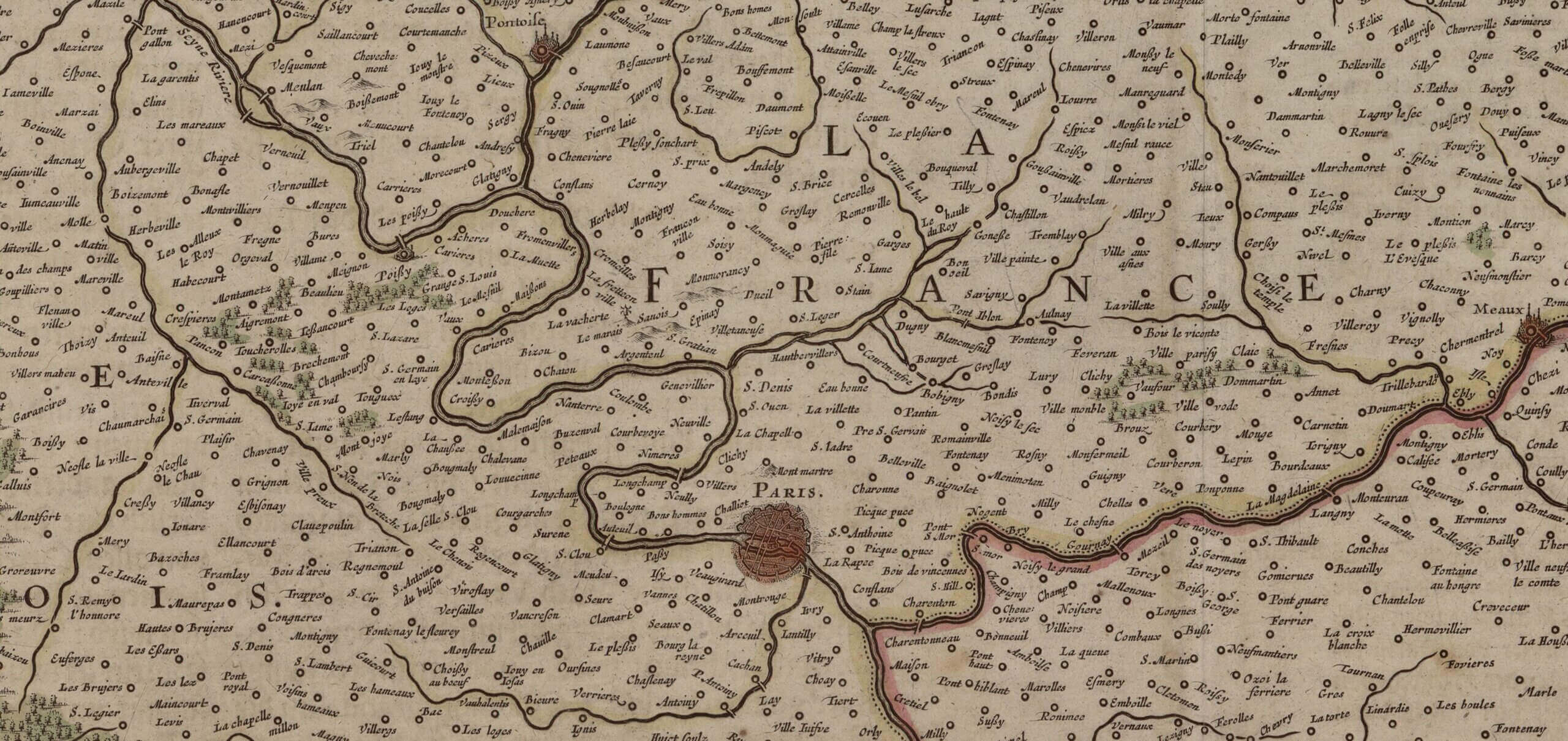
France is divided into approximately 35,000 communes (French communes include cities, towns and villages). That can make it difficult to find a specific location on a French map!
A French place name can cause all sorts of problems in genealogical research. It may have been misspelled, changed over time, or belonged to a commune that no longer exists. There may also be several places with the same name. And sometimes, what appears in a family record or document simply does not correspond to a real place at all.
In this article I’m going to show you what five issues you may run into while trying to research your ancestry, and what you can do about them.
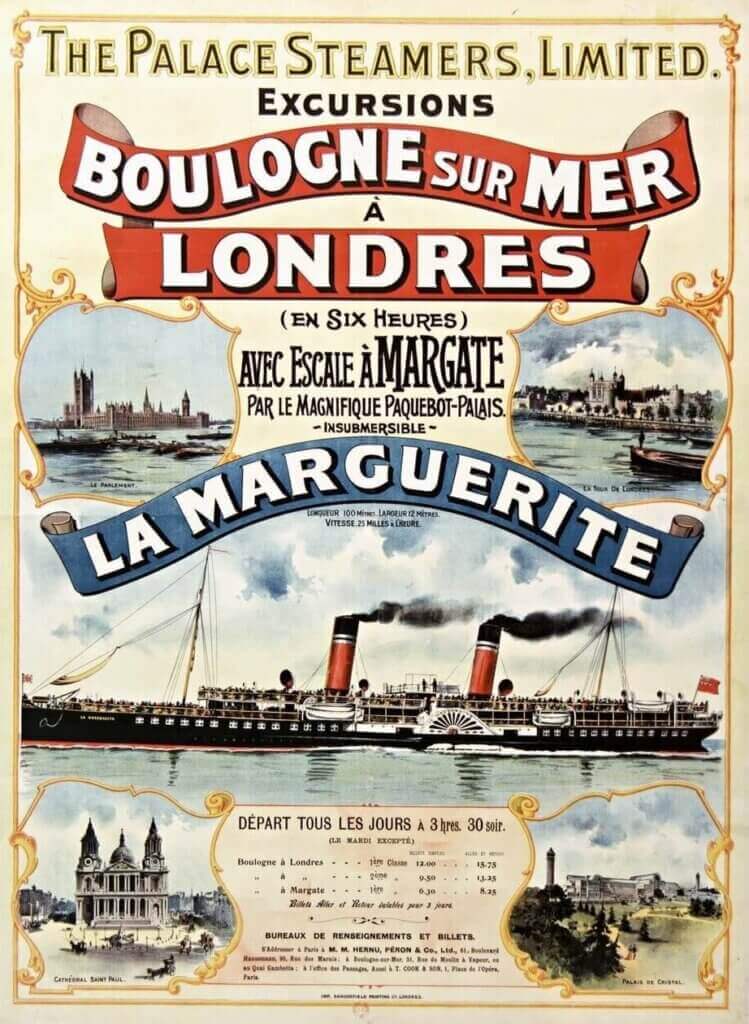
Colour lithograph travel poster from 1900 advertising steamship excursions between Boulogne-sur-Mer and London aboard “La Marguerite”. The town of Boulogne-sur-Mer is located in northern France. It belongs to the Pas-de-Calais department, one of France’s 101 administrative divisions. Pas-de-Calais is home to 887 communes, more than any other department in France.
Source: Bibliothèque nationale de France.
Trap 1 — What to do if a French place name is misspelled?
Of all the challenges of researching French family history, misspelled place names are probably the most common. Place names become incorrect for three main reasons.
When information was passed on verbally (declarative), the spelling that appeared in a record often depended on what the person knew. Sometimes, the person knew little to nothing about how to spell their birthplace or residence.
The place name could have been unfamiliar to the recorder.
It should come as no surprise that many foreign record keepers were completely unfamiliar with French places. They wrote them as close to the French pronunciation as they thought was appropriate in their own language. Bordeaux became “Bordax”, Roissy became “Roicy”, and even “Toulon” became “Tulong”.
You can probably guess what these misspellings actually stand for if you are French, but if you are unfamiliar with the country, these differences could turn out to be quite frustrating.
Online indexing can introduce new errors.
Genealogy websites have made historical records much easier to access, but they can also introduce new mistakes. A place name may be misread or incorrectly indexed by a computer or by someone unfamiliar with French history and geography.
Actionable Strategies
Prioritize the personal details
Search by surname and look for places that sound roughly like what you can read.
I once worked for a British family that had been trying to find information about a family member in the horse-racing business. He was apparently born in France, but the name of the town was unclear, despite being mentioned in several documents.
The family believed he came from southern France, so they focused their search there, without any success.
Using his name and a precise birthdate found in an English census, I located a promising birth entry. I then found his military registration record which confirm he was the right ancestor (it showed his address in England!). Their ancestor’s birthplace turned out to be a stud farm with longstanding English connections. He was from a small village in Burgundy, France, about 600 km to the north of the area the family thought he was from.
Be especially careful with common names. French surnames such as Moreau, Bernard, Martin or Petit, and given names like Jean, Jeanne, François or Françoise, appear in almost every town and every generation.
Search by “Cluster”
Look for immigration records, census entries, and church records that mention other family members or witnesses. A different clerk might have written down the name of a French town correctly.
Search using database wildcards
Most databases let you use a wildcard, usually an asterisk (*), to find matches. You could also use a question mark (?) to represent one character. So, for example, you could search for ‘Bodx’ and the database will find ‘Bordeaux’. You can also try searching for the first three or four letters of the word or use a phonetic search if available.
Run search engine geographic prompts
You can sometimes get great results simply by typing in what you see. You can also try uploading the record to a website that uses AI to decipher the text (though so far, I haven’t been impressed with the accuracy of the results for challenging handwriting).
Trap 2 – What if the place is the wrong one?
You found the place, but when you look for a record in that location, you find nothing. You might assume the document was lost or that you have the wrong person. However, the event may have actually taken place somewhere else.
Of the many records I reviewed related to the French diaspora, immigrants more often than not listed Paris as their place of origin or last residence (see “Trap 5” for non-French cases). There are several possible reasons for this. Paris was, of course, well known even aborad, and much easier to name and spell than a small French town. For some people, the precise place may simply no longer have mattered. Others may have deliberately kept details about their origins vague, particularly if they did not want to be identified or traced. And information can easily become simplified as it passes from one person to another: “near Paris” becomes “Paris,” and eventually that is the only place anyone remembers.
In any case, naturalization documents, obituaries, and gravestones may indicate Paris even if the person was born or married in a nearby suburb, or even in another part of France. The same can apply to other large cities, which sometimes served as convenient shorthands.
For someone looking at the record from thousands of miles away, what difference does it make whether a person died in Paris or in another place? Quite a lot, if you are trying to find the actual record. To a distant researcher, “Paris” may seem close enough. To a genealogist following the paper trail, it can send you looking in the wrong place entirely.
Actionable Strategies
Treat major cities as hypotheses
If you can’t find what you’re looking for, keep an open mind. The record might be associated with a different place. Compare different types of records. A death certificate may state “Paris”, while a French military record or marriage record will name the specific place. Until you find the original record in a French archive, don’t trust any place name that looks official.
While browsing the archives of Neuilly-sur-Seine for non-French people who died there (yes, I really do enjoy doing this; I consider it fun :-), I came across Johnny Dunn, the famous jazz trumpeter born in Memphis, Tennessee, in 1897 who died of turberculosis in 1937. Find a Grave listed his place of death as Paris. Of course, I corrected this. And believe me, this is far from the only time I have come across this.
Search adjacent suburban communes
Consider whether the event might have taken place in a neighbouring place. For Paris, look for places such as Neuilly-sur-Seine, Saint-Cloud, Vincennes, or Levallois-Perret. These communes have their own civil-status records.
Trap 3 — What if the French place no longer exists?
Even if you can actually read the name of the French place where your ancestor was born, you may not be able to find it on a modern map. It may have ceased to exist, been renamed, or been absorbed into another commune. The landscape of France has changed dramatically throughout history, and not always in predictable ways.
Merger
Several places formed a new place
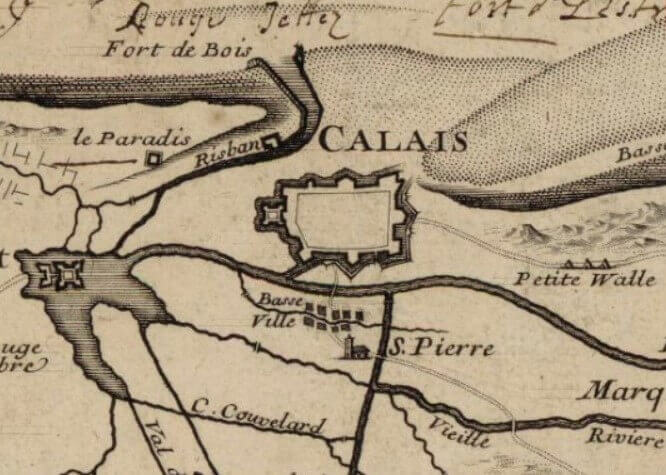
Detail from a 1709 historical map showing Calais and its surrounding settlements, including Saint-Pierre-lès-Calais prior to its merger with Calais in the nineteenth century.
Source: Bibliothèque nationale de France (Gallica)
Renaming
The place still exists, but under a different name
During the French Revolution, 1,200 or so towns and villages had their names changed to distance themselves from the royalist or religious connotations associated with their previous names. The Breton town of “Port-Louis”, which was named after King Louis XIII at the start of the 17th century, was renamed “Port-Liberté” during the French Revolution and eventually again reverted to Port-Louis in 1814. Fewer than a hundred of the newly-adopted revolutionary names survived beyond the Restoration.
The present-day “La Roche-sur-Yon” was called “Napoléon” when it was founded in 1804, then “Bourbon-Vendée” during the Restoration and again “Napoléon” in 1848, and finally “La Roche-sur-Yon” in 1870.
This is only one example among many of places which have changed their names from the Middle Ages to the present day.
For instance, the little village of “Illiers”, in Eure-et-Loir department, was renamed “Illiers‑Combray” in 1971 in tribute to the famous French writer Marcel Proust, who imagined a fictitious village called “Combray” in his book À la recherche du temps perdu (In Search of Lost Time), which he partly based on “Illiers”. Last example : “Châlons-sur-Marne” became Châlons-en-Champagne in 1998.
Note that even after a place has officially been renamed, people may have continued to use an old name in everyday speech, or correspondence. Some documents, including genealogical records, may also continue to use its former name.
Annexation
Smaller place incorporated into a larger one
If you discover that your ancestor was born in Bercy in 1854, you will need to dig a little deeper to discover that Bercy was then a separate commune on the right bank of the Seine, known for its wine warehouses. It was incorporated into Paris in 1860 and is now part of the 12th arrondissement, in the south-east of the city. You should therefore look for the birth record in the Paris Archives.
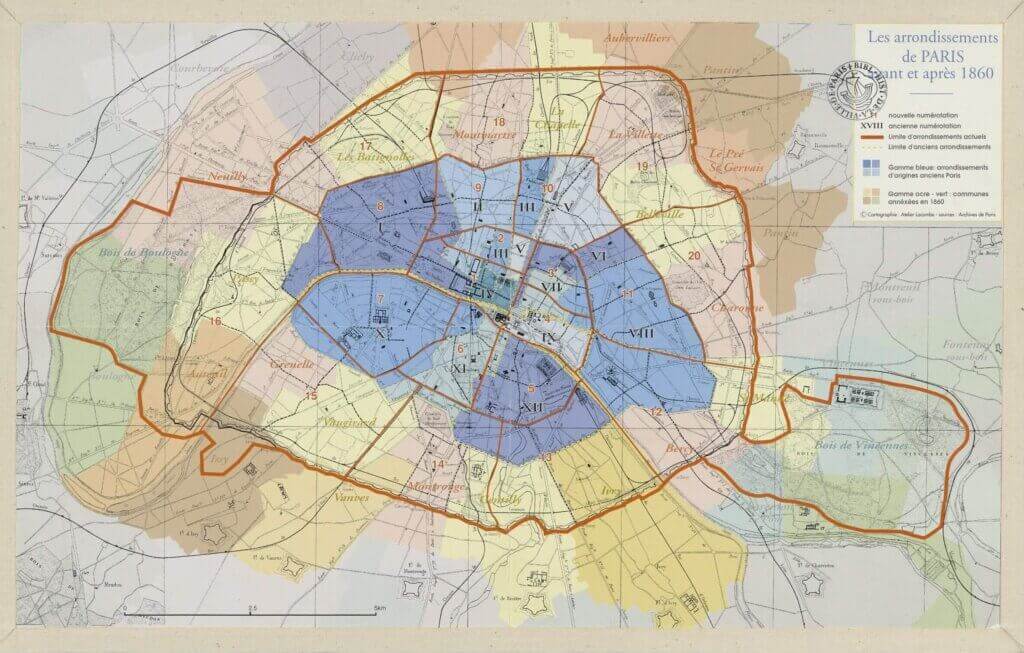
Map showing the expansion of Paris in 1860. The blue areas represent the former arrondissements of pre-1860 Paris, while the red boundary marks the enlarged city limits after the annexation of surrounding communes such as Belleville, Grenelle, Vaugirard and La Villette. Source: Bibliothèque Historique de la Ville de Paris (BHVP)
The places mentioned in your records often have histories of their own, and no single article could cover all the possible changes you may encounter. Instead, these are some of the most common situations to look out for, along with a few general principles that can help you identify a place even when its name no longer appears on a modern map.
Actionable Strategies
Check online
Unfortunately, there is no English online tool that would allow you to look specifically for this kind of information.
You may use a search engine or your preferred IA tool. For instance, if you enter “Charleville,” the system will suggest “Charleville-Mézières.”
Trap 4 — What if multiple places share the same name?
Even when you can read the place name in your ancestor’s record and find it on a modern map, you may still not have found the right place. There are numerous place names in France that are identical or very similar, sometimes hundreds of kilometers from each other.
It is not uncommon for a particular location to share the same name as another because they draw on common elements: saints, waterways, “new towns”, aristocratic names/geographical features. For example, six French towns bear the name “Villeneuve”, translated as “new town”. The number is much higher if we consider variations on the name, and there are approximately 80 towns containing this name, including “Villeneuve-sur-Lot”, “Villeneuve-lès-Avignon”, and “Villeneuve-Saint-Georges”. This figure increases further if we include hamlets.
You might reasonably assume that anyone recording a place would give its complete name. This was not always the case, especially for people who had emigrated and who may simply have written “Villeneuve” because, for them, there was only one Villeneuve: the place they came from. And it may have been the official name of that place at the time.
The same occurs with many other common French places. France has numerous communes called “Saint-Martin”, “Saint-Jean”, “Saint-Pierre”, “La Chapelle”, “Beaumont”, “Montfort”, “Bellevue”, “Bois” and so on. These names occur repeatedly across different regions, sometimes dozens of times.
Actionable Strategies
Map family clusters
If other records from different relatives point to a specific region, for example, Lot-et-Garonne, then “Villeneuve” is likely to refer to “Villeneuve-sur-Lot”. If they were living near Paris, it is possible that their addresses would be “Villeneuve-Saint-Georges” or “Villeneuve-la-Garenne”.
Analyze surname frequency in candidate registers
Enter the surname of your ancestor on your favourite family history website. The commune showing a high concentration of your ancestor’s surname is your target.
Trap 5 — What if your ancestor wasn’t French?
It is important to know that not every ancestor with a French-sounding name is actually French. This particular trap is more subtle, but it can lead your research into the wrong country’s archives.
Therefore, the term Frenchman does not necessarily mean that the person was born in modern-day France, and identifying the person as such may lead you to erroneous conclusions in your research.
German by record, French by birthIt is not uncommon for documents to refer to people by nationality erroneously. For example, in census records, a Frenchman may be erroneously recorded as German, and vice versa. If you find a record referring to your French ancestor as German, before jumping to conclusions, you must first consider the possibility that the person you are looking for may have been born in present-day France.
Alsace‑Lorraine is a region in France that borders Germany, Switzerland, and Luxembourg. After losing the Franco‑Prussian War in 1870 – 1871, France was forced to cede Alsace‑Lorraine to the newly formed German Empire. The territory of Alsace‑Lorraine is 15,000 square kilometers, approximately 1,705 communes, and a population of nearly 1.9 million people. It was returned to France after the First World War and was occupied again by Germany during the Second World War.
The area covered by Alsace‑Lorraine roughly corresponds to the present-day Bas‑Rhin, Haut‑Rhin, and Moselle départements in the Grand Est region of France. Thus, in principle, a person who was born in Strasbourg in 1860 could be both French and German throughout their life. In addition, civil registration documents for Alsace‑Lorraine were traditionally composed in German and are still available in French archives.
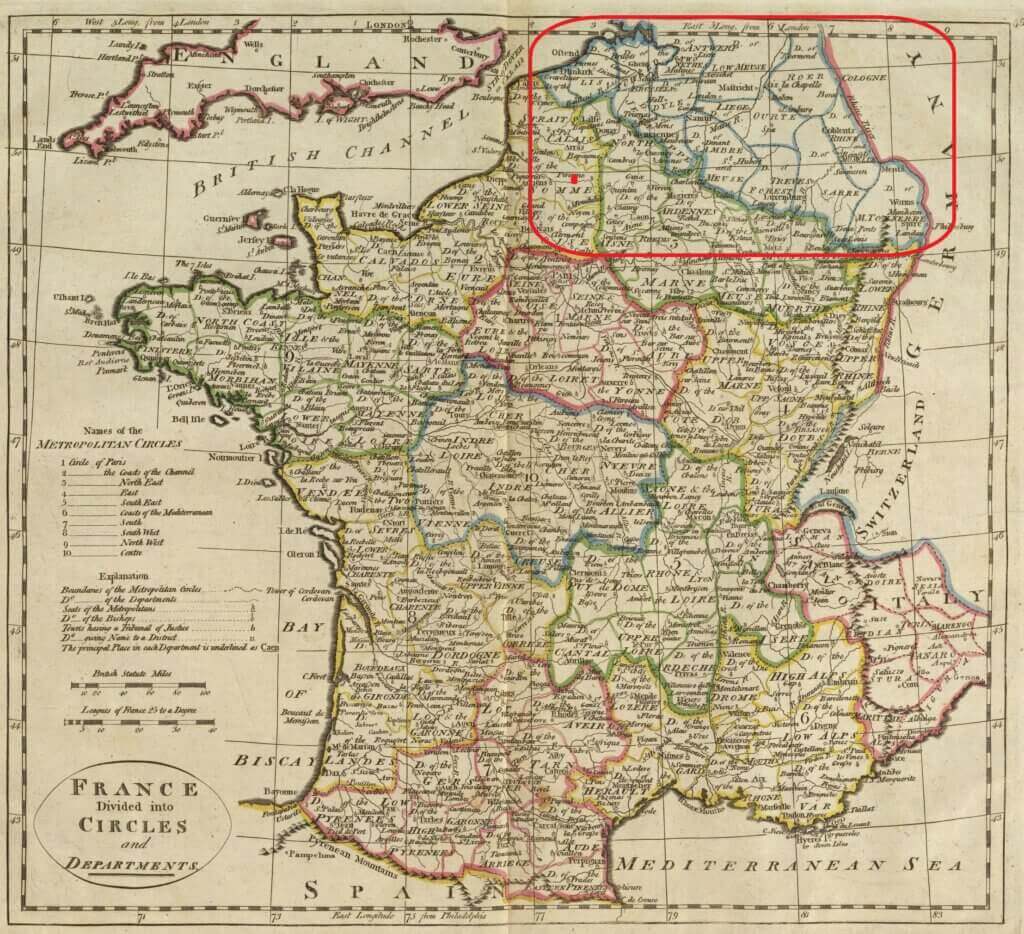
France Divided into Circles and Departments by Mathew Carey (1814) depicts France at the time of the French Empire’s end and shows how modern-day Belgium was incorporated into France’s territories. Source: David Rumsey Map Collection.
A Frenchman … or a Belgian ?
Fans of Agatha Christie will remember that Hercule Poirot was frequently inaccurately referred to as a Frenchman. He was, naturally, a Belgian, and took significant offense at the misunderstanding. The reason for the confusion was because he spoke fluent French and had a French-sounding name, and the cultural (and physical) boundary between the two countries was not always obvious to an outsider.
Belgium’s history is intricate, and a brief overview cannot do it justice. That said, you should know that Belgium was annexed by France in 1795 and remained a part of France until 1814.
The territory was formally directly a part of the French Republic, meaning that the people there were French citizens according to the law. A person born in Ghent in 1805 was therefore born French; if they emigrated later, they may have described themselves as Belgian (after Belgium became independent in 1830), or the record might label them French simply because they were born under French rule.
The term “French” on a document (often a census) does not guarantee that the person was born within France’s modern borders. Assuming so can potentially compromise your research.
German by Record, French by Birth
Say you find a record that describes your ancestor as being German, and another that states she was French (this is very common in census returns). Before you decide that your French research has gone astray, consider where in “Germany” they might have come from.
The historical region of Alsace‑Lorraine lies in what is now north‑eastern France. It borders Germany to the east, Switzerland to the south, and Luxembourg to the north.
After the Franco‑Prussian War of 1870 – 1871 (Prussia being the kingdom that led the German states), the region was annexed by the newly created German Empire. France was forced to cede a vast territory of about 15,000 square kilometres. It comprised 1,705 communes with a population of roughly 1.9 million inhabitants.
It remained under German administration until 1918, and was occupied again between 1940 and 1945.
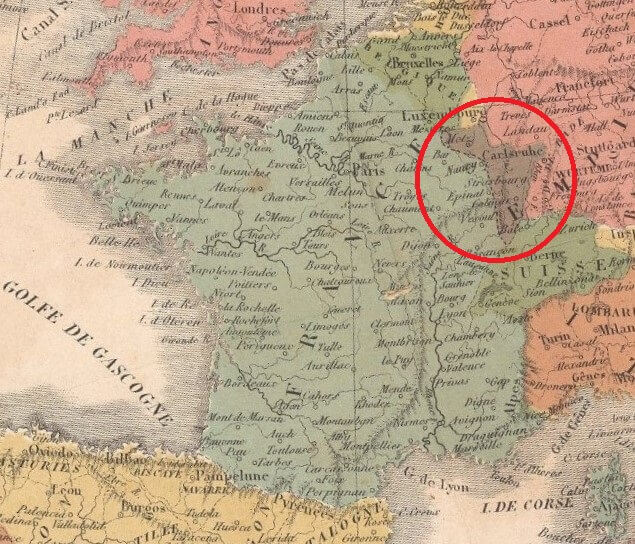
Extract from Théodore Lefèvre’s 1871 map “Nouvelle carte d’Europe avec toutes les dernières annexions”, showing Alsace‑Lorraine.
Today, Alsace‑Lorraine roughly corresponds to the French administrative region of Grand Est consisting of three départements: Bas‑Rhin, Haut‑Rhin and Moselle.
Someone born in Strasbourg in 1860 could quite plausibly have been born French, lived most of his life in Germany and died French once again.
Vital records were very often kept in German, as were all other civil registers, and are today housed in French public archives.
Actionable Strategies
Correlate migration dates with border changes
Check whether your ancestor emigrated before or after major border shifts.
Search the full name
In most cases like this you can possibly find a second document (for example, a naturalisation paper) that gives the correct place.
Cross-reference multi-country databases
Use international archival databases (such as Filae or FamilySearch) to evaluate whether your ancestor’s surname concentrates primarily in French-speaking Belgium or the borderlands of Alsace.
If an ancestor is recorded as German and the records do not add up, consider Alsace-Lorraine, and pay close attention to whether they left before or after 1871
Conclusion
The main takeaway is simple: never discard a record just because the place name looks wrong or unfamiliar. In French genealogy, identifying the right place — and understanding what that place was called and where it belonged at the time — can make the difference between a dead end and the next generation.
Join the list
Subscribe to RFMM Newsletter! Once a month I share one useful tip, coupons and one bit of French history, all in English.