
Summary
If you are searching four your French roots, the birth, marriage and death records will rapidly become your most valuable asset. In France, they are know as ‘actes d’état civil‘ and represent the equivalent to civil registration records, also called vital records or BMD records.
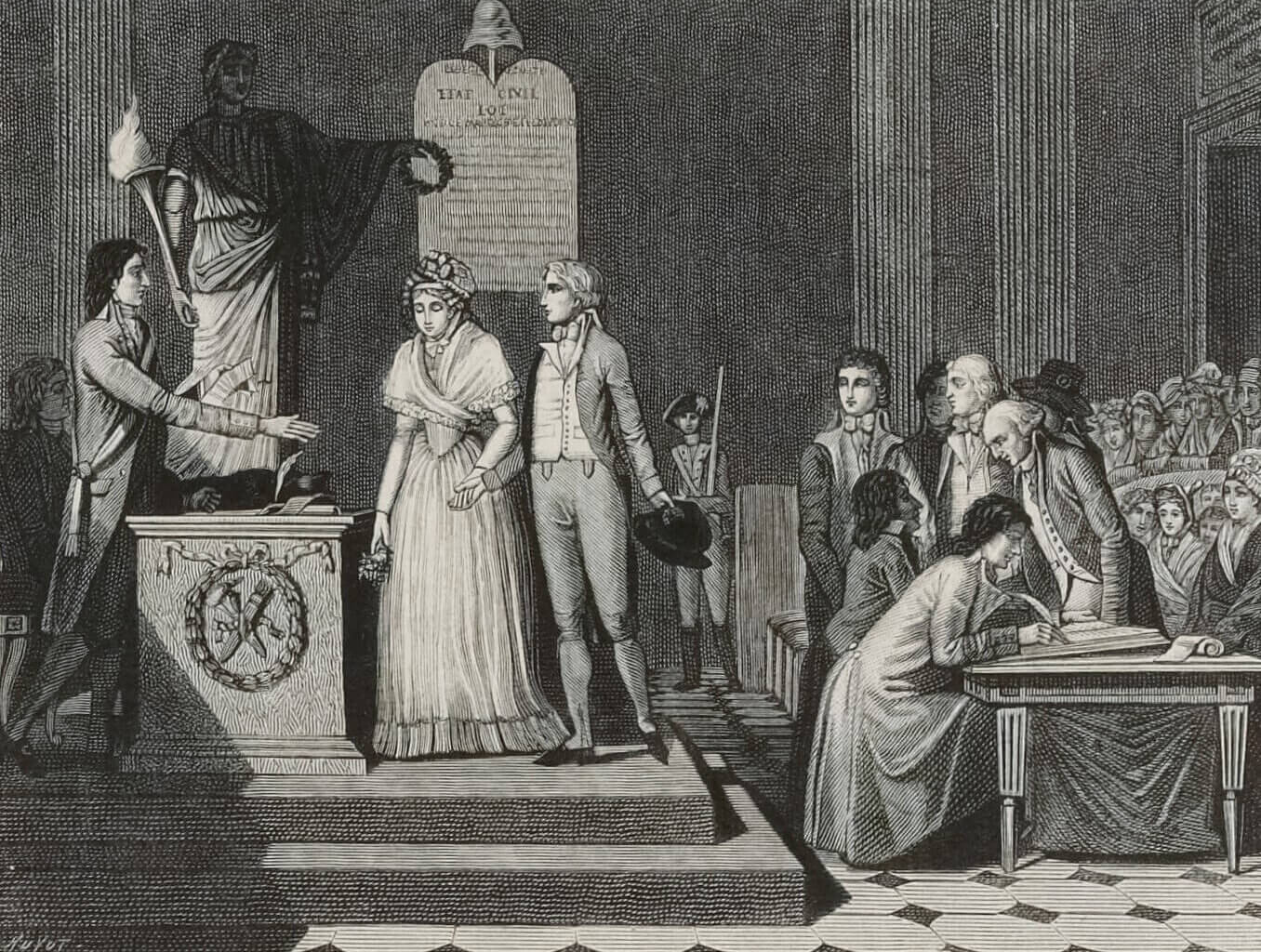
The civil registration system came into effect in 1793 during the French Revolution. It replaced Catholic parish registers as the official means of recording vital events.
While many of these records are available online on various family history platforms, there is still a large amount of unindexed digital collections as well as offline records for you to explore.
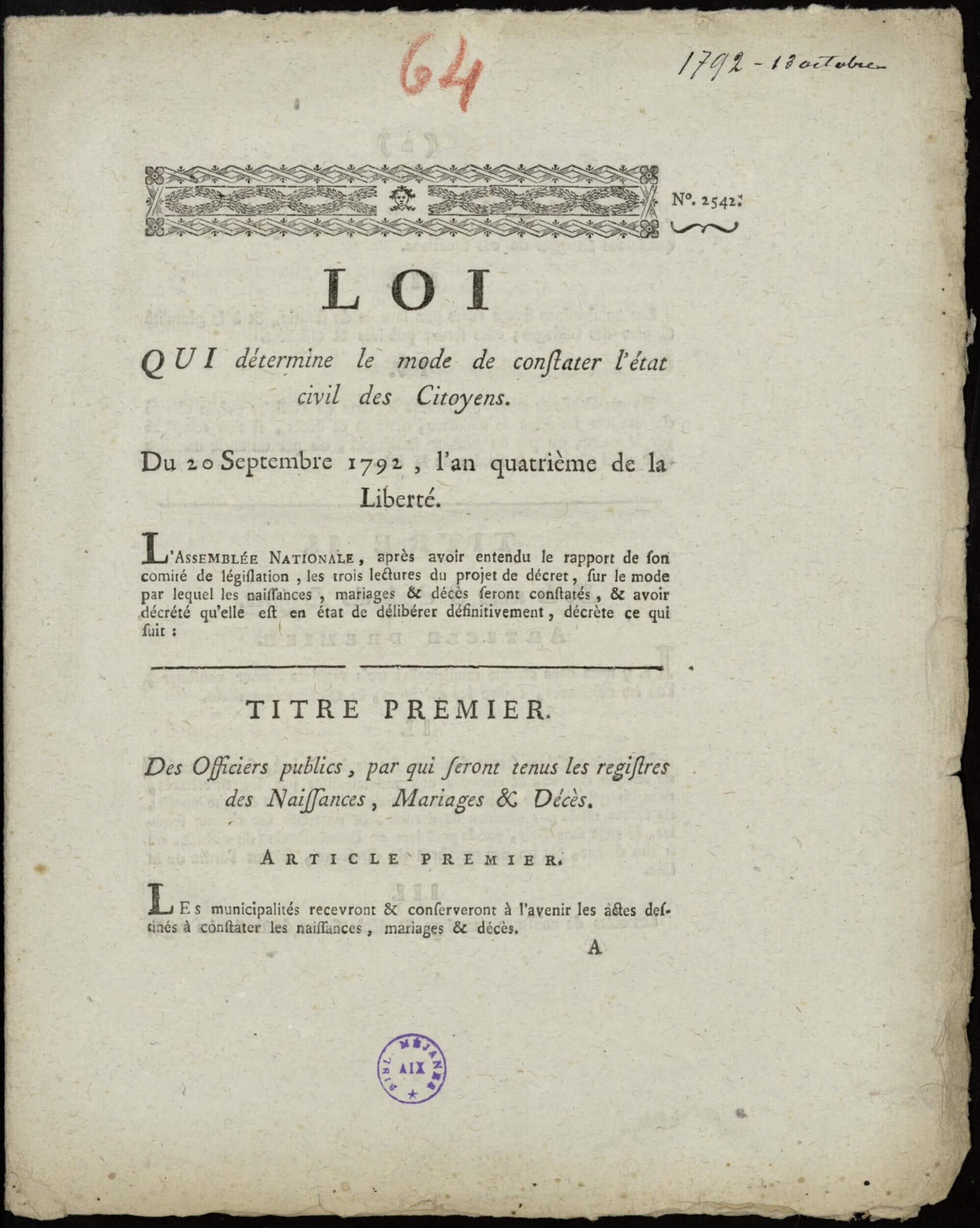
Act determining the procedure of registration of citizens. 20 September 1792. Source: Méjanes Library, Aix-en-Provence (Ref. 1792.10.13)
This article explains where to find them, how to know if they are online, and what to do if the are not. It provides an overview about:
- Which archives hold French birth, marriage and death records
- When these records become available to the public
- How to find an unindexed French birth, marriage or death record online
- How to obtain a French birth, marriage or death record when it is not available online
The history of civil registration in France covers more than two centuries and was subject to a number of laws and regulations. It is still being modernized to this day. Although there are always legal or historical exceptions and local peculiarities, having an understanding of the general principles is still very helpful for successful research.
Beyond Births, Marriages and Deaths
Although French civil registration primarily records births, marriages and deaths, the registers also include other related events.
In Births Registers
Acknowledgment of parenthood (reconnaissance)
Since the Civil law, inherited from the Napoleonic Code of 1804, and until recently, a child born outside of marriage could not have a legal filiation to a parent until they were officially recognized. In most cases, it was the mother who did so, and the child would bear her name, as the father was very often listed as ‘unnamed’. Despite the recognition, the child was still considered a ‘natural child’ (enfant naturel) and could not claim the same rights as a legitimate child, notably in terms of inheritance.
Foundlings (Enfants trouvés)
Occasionally, birth registers record a foundling. In addition to the date, place and circumstances of discovery, the child’s apparent age and sex were specified, as well as any clothing, objects or documents found with the child. A name was usually given to the child.
In Marriage registers
Marriage banns (publications de mariage)
Before the marriage, the intentions of marriage had to be made public. Marriage banns were typically published twice in the weeks before the couple got married. The banns were exposed in the places where each would-be spouse lived. Records of marriage announcements may be kept separately from the actual marriage registers.
Divorce
Divorce (Divorce)Divorce was legalized in France in 1792. It was then restricted under Napoleon, abolished in 1816, and reinstated in 1884, albeit under restrictive conditions. Beginning in the late 19th century, some divorce judgements were transcribed in full in the marriage register for the location of the marriage.
In Death Registers
Stillborn children (Enfant sans vie)
Death registers also contain records of stillbirths. These children were not given names; instead, their sex and the date and time of death were noted, along with the names of their parents.
Which Archive Holds French Birth, Marriage and Death Records?
French civil registration records are held by various institutions. The first question, therefore, is which institution holds the record you need.
The general pattern is as follows:
– Records are created at the town hall, and recent registers remain there.
– Older registers, are transferred to an archive service.
– Specialized national repositories hold records for particular populations or territories.
The Town Hall — The Starting Point
Civil registration records are created and entered into registers at the town hall of the commune where the event took place.
Records are entered consecutively in a register, with several records usually appearing on each page. Each record is assigned a sequential number.
Terminology
Etat civil
The French system of civil registration.
Registre
A register, i.e. the physical or digitised volume/book containing civil records.
Acte
A record or entry: an individual birth, marriage, death, or other civil record.
Mairie
The town hall.
Commune
The basic administrative unit in France roughly equivalent to a municipality, town, or village). France is divided into over 34,000 communes, ranging from major cities like Paris and Lyon to tiny rural hamlets.
Département
A department i.e. an administrative division of France that is VERY roughly comparable to a county. Each department contains multiple communes.
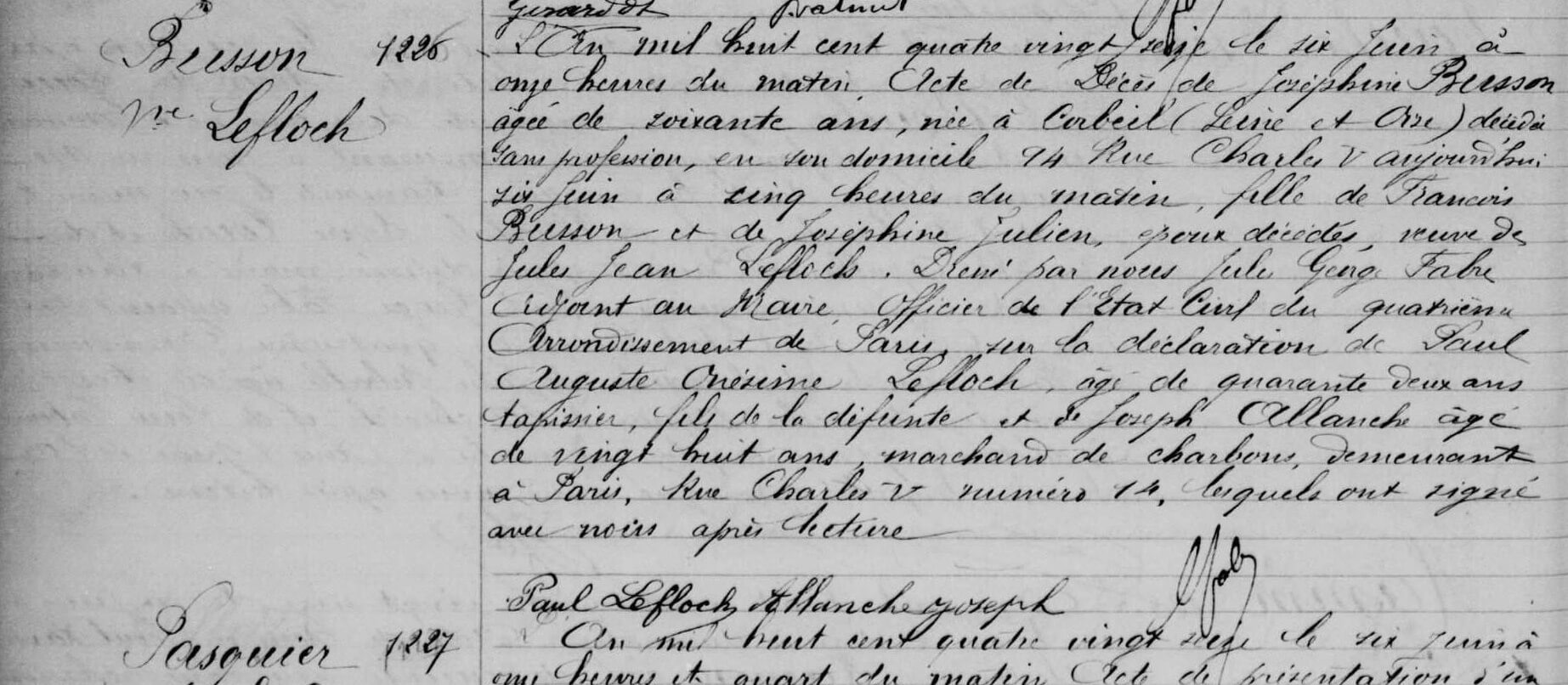
Extract from a French death register, Corbeil, 1896. Entry 1226 and 1227 appear consecutively in the register.
Source: Departmental Archives of Essonnes.
Each event is recorded by the civil registrar (officier l’état civil). By law, the mayor (maire) and the deputy mayors (adjoints au maire) are both the civil registrars though they can delegate these duties (except for marriages).
When Records Move to the Archives
Civil registration records are typically created in duplicate, with each copy following a distinct path and timeline.
The Townhall copy
The town hall copy of the register is maintained by the local registrar, who utilizes it to issue certified copies and record marginal annotations, including subsequent marriages, divorces, or deaths. Once a register reaches 120 years of age, it is transferred to an archive service.
The court copy
Each year, a second copy of the register is sent to the local court. The court retains this copy for a period of 75 years before transferring it to a historical archive, namely the Departmental Archives discussed below.
One copy may therefore still be at the town hall while the other has already been archived.
The Departmental Archives – The Main Destination
The Departmental Archives receives court copies of civil registration registers and frequently receives town hall copies after the applicable retention periods. However, their collections include a wide range of additional materials, such as parish registers, notarial records, census returns, military conscription lists, land and property records, newspapers, and numerous other local sources.
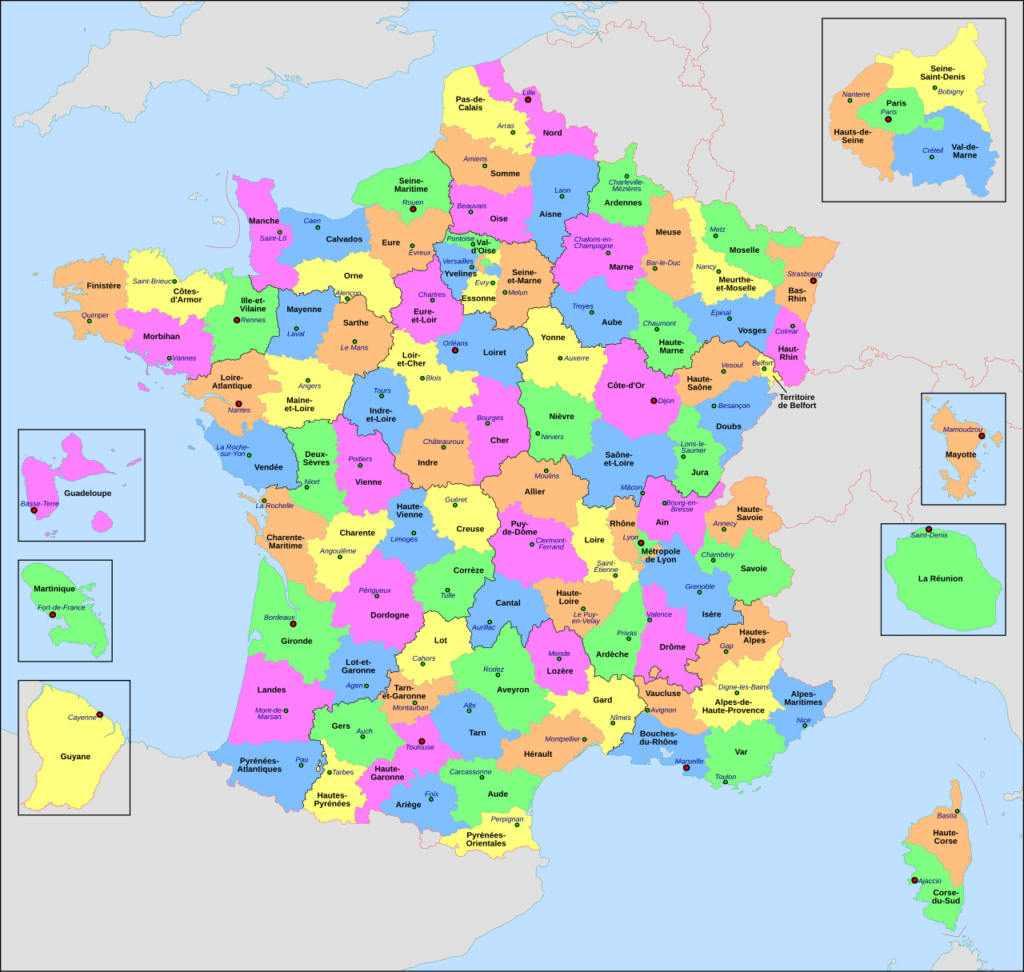
Prior to the French Revolution, France was divided into provinces. During the revolutionary period, the country was reorganized into administrative divisions called ‘départements’ (departments). There are currently 101 departments in France.
Source: Nilstilar, CC BY-SA 4.0 , via Wikimedia Commons
For most family history research involving older records, the Departmental Archives is the main destination.
Municipal Archives — For Large Cities and Towns
As long as proper archival conditions are maintained, communes with a population of 2,000 or more are not required to transfer their old registers to the Departmental Archives. Some communes maintain a dedicated municipal archive service (Archives Municipales). Cities such as Paris, Lyon, Marseille, Bordeaux and Rennes have extensive municipal archives that include historical civil registration records alongside many other local documents.

The façade of the Lyon Municipal Archives.
Source: Pemberlaid, via Wikimedia Commons.
However, bear in mind that even for these cities, the court copy of the registers is still sent to the departmental archives. Therefore, the two institutions may hold different versions of the same register.
Specialised National Repositories
While most French civil registration records are organized geographically at the municipal or departmental level, several categories of record are held by specialized national repositories. Each repository has its own access and publication policies. These include:
French citizens abroad
Former French territories
When can I access French Birth, Marriage and Death Records?
After identifying where a record is held, it is essential to determine whether consultation is permitted and, if so, in what form.
When it comes to public archives, it is important to distinguish between three stages of access.
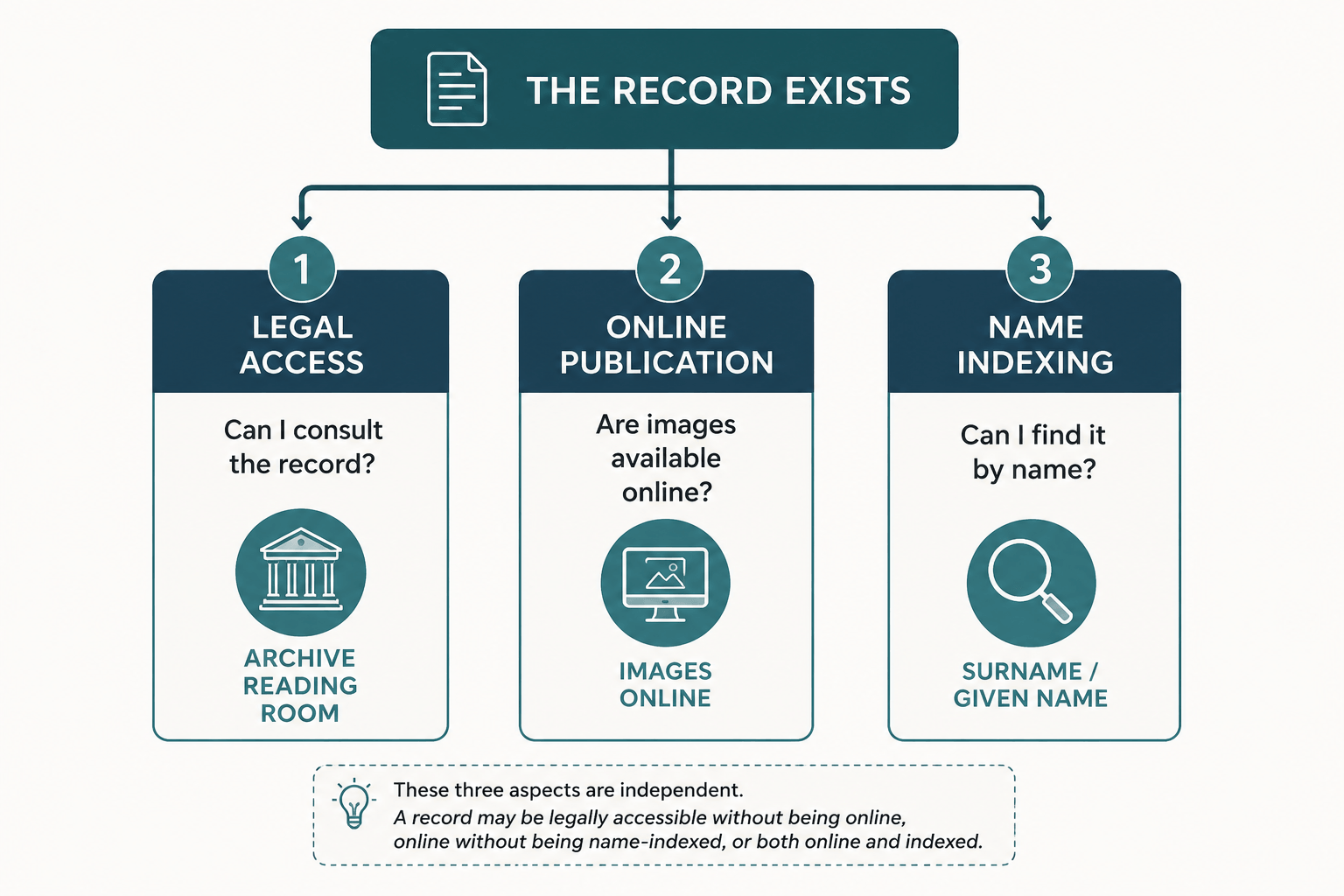
The Three Dimensions of French Registration Record Access in Public Archives
Each stage is governed by a distinct set of rules and concerns, primarily the protection of personal data.
- Legal accessibility refers to whether the record can be viewed in an archive reading room or a copy can be obtained. This matter is strictly governed by French law which establishes the statutory time limits for public access.
- Online publication indicates whether images of the register are available on the internet. This stage is subject to additional regulations regarding public administration and data protection. Archive services generally adhere to the historical guidelines set out by the French Data Protection Authority.
- Online name indexing determines whether an individual record can be retrieved by searching for a person’s name. This stage is also subject to its own data protection considerations. Archive services generally adhere to the historical guidelines set out by the French Data Protection Authority.
A record may be available for consultation before it appears online, and it may be published online long before it can be searched by name.
The following table consolidates the three timelines. The counting of periods is done from the closure of the register, which is typically the end of the calendar year.
| Record type | Public consultation | Online publication | Name indexing |
|---|---|---|---|
| Birth records | 75 years | – 75 years – 100 years if marginal notes are not redacted |
120 years |
| Marriage records | 75 years | 75 years | 100 years |
| Death records | Immediate | – 25 years | 75 years |
Please note that public consultation, online publication, and name indexing policies are subject to numerous exceptions and variations. It is necessary to consult with each archive service individually to ascertain their respective coverage.
Marginal Notes (Mentions marginales)
In the French civil registration system, a marginal note (also known as a mention marginale) is an update added to the margin of an existing record (specifically birth and marriage records). When certain events occur, such as marriage or death, the registering commune notifies the holding commune (provided they are not the same commune). The registrar then inscribes the update directly onto the margin of the record.
Certain events, especially those resulting from court rulings, must first be fully transcribed onto the civil registration register prior to the addition of a marginal note. This is the case for divorces, for instance, which are recorded in the marriage register.
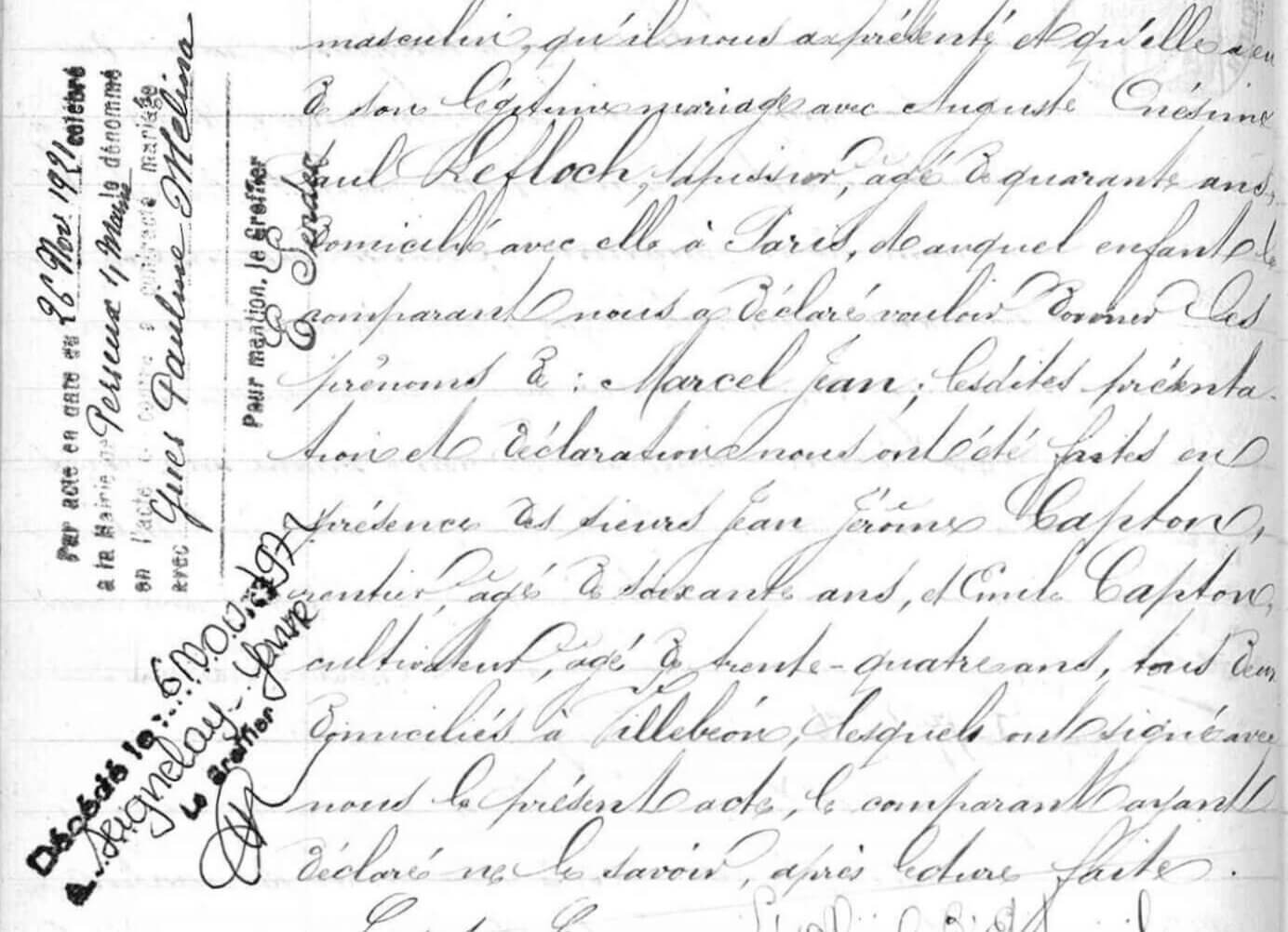
Extract from a French birth record. Two marginal notes are located on the left: one mentioning his marriage (including the name of his wife, the date, and the place of the event), and the second providing information about the date and place of his death.
Source: Departmental Archives of Seine-et-Marne.
The use of marginal notes was introduced gradually over time. The absence of a note on an older document is often indicative of the laws in force at the time rather than suggesting that the event did not occur. Additionally, the system is far from infallible. Marginal notes may be missing for various reasons, so their absence should never be taken as conclusive evidence that an event did occur.
Is the record legally accessible?
Ultimately, the purpose of all public archives is to facilitate public access and consultation. However, administrative laws and regulations strike a balance between this principle and other interests.
Restrictions primarily pertain to recent birth and marriage records, as well as records containing information about filiation or family status.
The periods commonly encountered are as follows:
| Record type | Public consultation |
|---|---|
| Birth records | 75 years |
| Marriage records | 75 years |
| Death records | Immediate |
Periods are counted from the closure of the register
Early access to restricted records
In certain circumstances, access to a record that is not yet freely accessible may be authorized before the applicable public access period has expired.
The following individuals are entitled to consult the record and request a full copy of the original record directly from the town hall. A full copy is defined as a complete reproduction of the original record.
- the individual listed in the record (of legal age);
- their spouse or registered civil partner (partenaire de PACS);
- their direct descendants or ancestors (children, grandchildren, parents and grandparents);
- their legal representative;
- certain authorized professionals within the scope of their legal duties.
If you do not fall into these categories, however, you can apply for early access via a formal legal procedure known as a demande de dérogation (request for special exemption); however, approval is not guaranteed. The administration will consider your motivation, which must be justified and legitimate, such as for academic research, historical publication or establishing a legal right, against the privacy interests protected by law.
Has the record been published online?
Over the past two decades, a vast quantity of material has been made available online. Civil and parish registers are typically among the first series made available, as they are the records most frequently requested by genealogists
However, online publication does not equate to legal consultation. While a register may be legally accessible in the reading room, the archive service may still decide not to publish the images online. This is because online publication is subject to a different, more restrictive framework.
Online publication is subject to public data and data protection rules because publishing a register on the internet makes personal information easily accessible worldwide.
In practice, archive services generally adhere to the historical guidelines on this subject, as established by the French Data Protection Authority.
While these timeframes reflect current practices, significant differences between archive services are to be expected depending on technical constraints, local authorizations or other factors.
| Record type | Online publication |
|---|---|
| Birth records | – 75 years – 100 years if marginal notes are not redacted |
| Marriage records | 75 years |
| Death records | 25 years |
These periods are measured from the closure of the register.
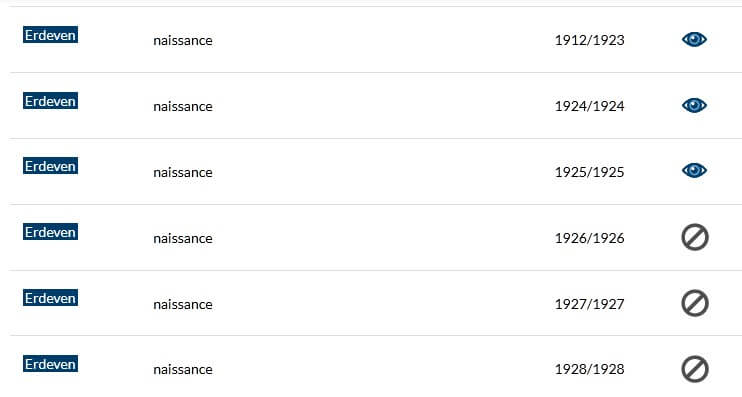
This screenshot illustrates that the online birth registers for the commune of Erdeven on the Morbihan Departmental Archives website end in 1925–1926, showcasing a publication limit that is encountered on some archive websites.
Source: Morbihan Departmental Archives
Can I search for it by name?
This is addressed separately from online publication because the exposure of personal data is far greater, and an additional protection period is applied before this level of facilitated searching is permitted.
When a register is not searchable by surname, you must browse it page by page, just as you would when consulting a physical register.
The commonly applied name-indexing periods are:
| Record type | Name indexing |
|---|---|
| Birth records | 120 years |
| Marriage records | 100 years |
| Death records | 75 years |
These periods are counted from the closure of the register.
Many archive websites offer a name-search form directly on their site. However, the mere presence of such a search box does not guarantee that every record has been indexed, and coverage can vary significantly between collections.
These name indexes may have been created in different ways: by archive staff, by associations, through collaborative indexing projects, or, through automated transcription projects.
How to Find an Unindexed French Birth, Marriage and Death Record?
An unindexed register is not necessarily unavailable online. You may be able to view every page as a digitised image, but you cannot retrieve an individual record by searching for a name. You must therefore browse through the register itself, much as you would with the original documents in an archive reading room.
Many online registers have not yet been indexed by name. In such cases, two main finding aids are available to locate an event without reading every page of the register: the annual index and the ten-year index.
The annual index
Once the register for a given year has been closed, an alphabetical list of all the records entered in that register is compiled. This is the annual index, known in French as the table annuelle. It is generally located at the conclusion of the register; however, some archives present these tables online as a distinct item. The following information is provided:
- the surname and given name;
- the event date;
- in some cases, the entry number, and/or the page number.
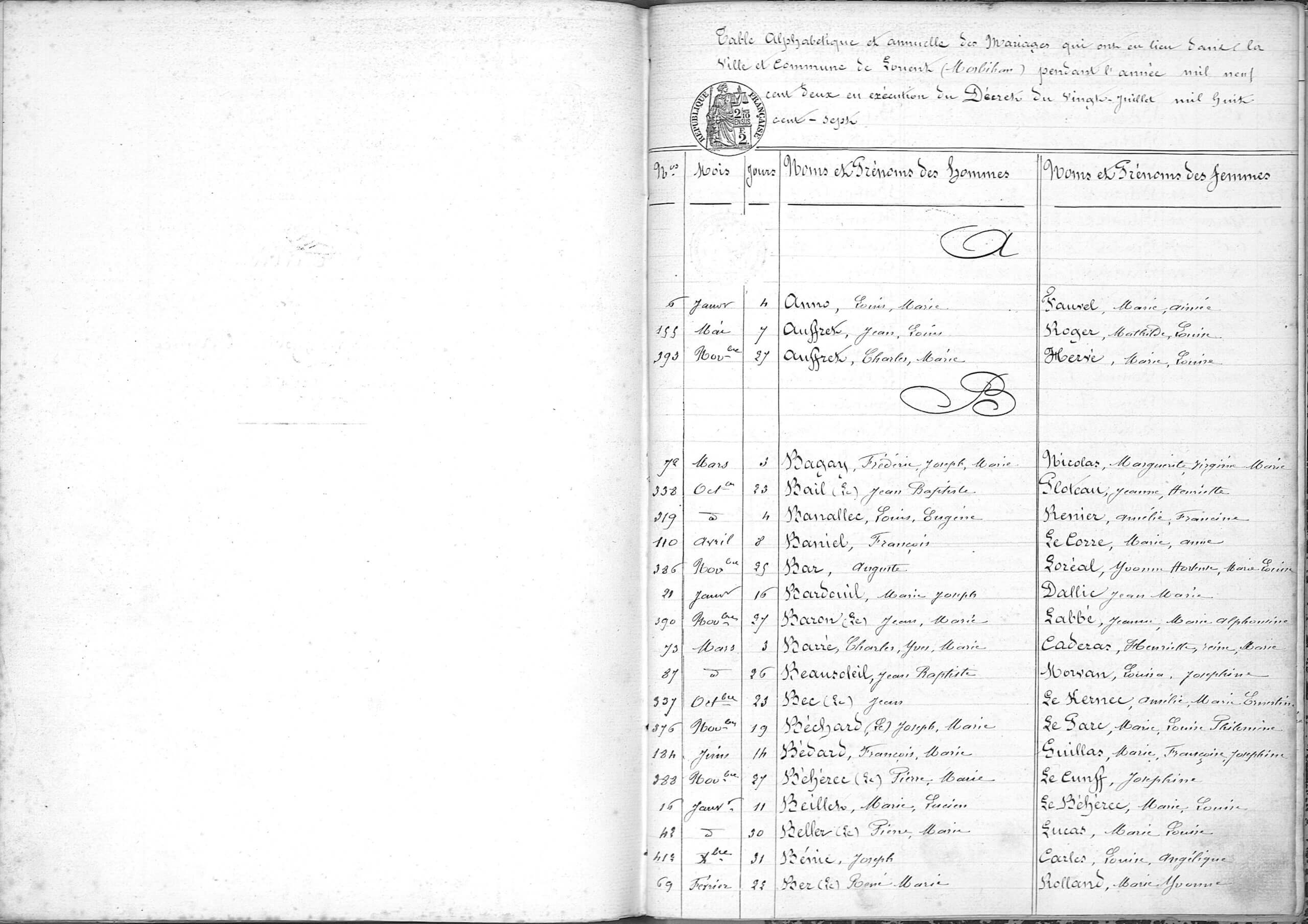
Source: Morbihan Departmental Archives
The annual index is a valuable tool when you have a general understanding of the year but need to determine the exact date of an event.
Once you have located the relevant entry in the index, you can use the date and entry number to find the corresponding record in the register. Locate the corresponding register for that year and identify the record itself. Note that the entry number is the most efficient method to locate a record in a register.
The ten-year index
The ten-year index, also known as a table décennale, is an alphabetical index that covers ten years of events in a single commune. It is created from the index tables. These tables are typically organized first by record type and then alphabetically by surname.
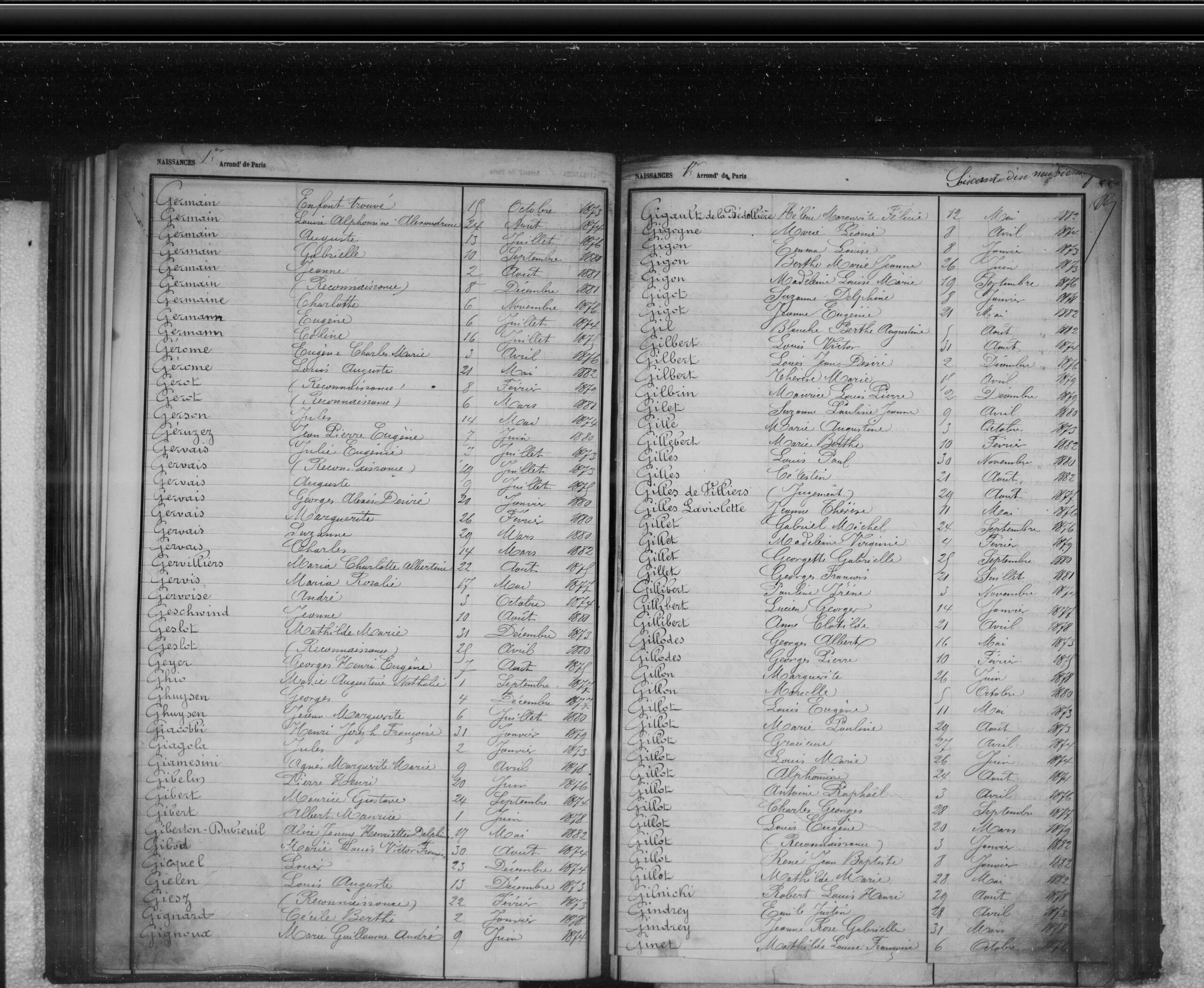
Extract from the birth ten-year index, 1873–1886, 1st arrondissement of Paris. One foundling (Enfant trouvé) and three acknowledgements of parentage (Reconnaissances) are visible.
Source: Paris Departmental Archives.
This index is particularly useful when the precise year of the event is unknown or only a general timeframe is available.
The procedure is identical to that of the annual index: locate the surname, note the date and record number, and then turn to the corresponding record in the register.
How to Obtain a French Birth, Marriage or Death Record When It Is Not Online?
At this point, you most likely already know the commune and approximate period that you are looking for. Even if the record is legally accessible but not available online, there are still a few options available to you.
Consult the Register in an Archive Reading Room
Public archives generally offer free on-site consultations. Most institutions require prior reader registration and presentation of an identity document.
Of course, this option requires you to be in France and to visit the relevant archive service in person.
Request a Reproduction from an Archive Service
If the record is held by an archive service and is legally accessible but you cannot consult it in person, you may be able to request a reproduction.
Most archive services accept written requests for reproductions of specific records, provided the reference (commune, type of act, year, and, if possible, the exact date) is precise enough to locate the record.
Depending on the institution the reproduction generally takes the form of a digital scan sent by email or a photocopy sent by post.
Fees vary from one service to another, and reproduction may be refused for conservation reasons when the register is fragile.
Request a Full Copy from a Town Hall
If the record is legally accessible but the register is still held by the town hall and is not available online, you may be able to request an official copy directly from the town hall.
The town hall issues these official documents in accordance with the original register, thereby conferring upon them both administrative and legal value.
You can request a copy by email, mail or in person. Official copies are available free of charge from France.
Conclusion
Finding a French birth, marriage or death record does not yet only involve searching a single database for the correct name. Records may be held in departmental, municipal archives or at the townhall. They may only be available as images. They may be hidden within unindexed registers or subject to access restrictions due to their date. Therefore, the useful distinction is not simply between records that are online and those that are not. It is between records that are online and and records that exist, but require a different access route.
This overview presents the essential framework for navigating French civil records. While a single article cannot cover every nuance of legal and administrative history, understanding these three core categories is the key to conducting a targeted, efficient search. These are the same questions that a professional researcher considers automatically before looking for a record.
Join the list
Subscribe to RFMM Newsletter! Once a month I share one useful tip, coupons and one bit of French history, all in English.