Summary
Today, France has around 35,000 communes (any town, city, or village in France), a figure unmatched by any other European country.
To put that into perspective, the United Kingdom, with a comparable population, has roughly a third of that number of civil parishes (the closest equivalent).
The Boulogne-sur-Mer shown in the lithograph on the right is a town in northern France. It belongs to the Pas-de-Calais department (very roughly comparable to a county or province), which today comprises 887 communes — more than any other department in France.
For anyone, this sheer number of places creates a surprisingly complex geographical landscape. Before you abandon a lead, it helps to understand why these errors happen.
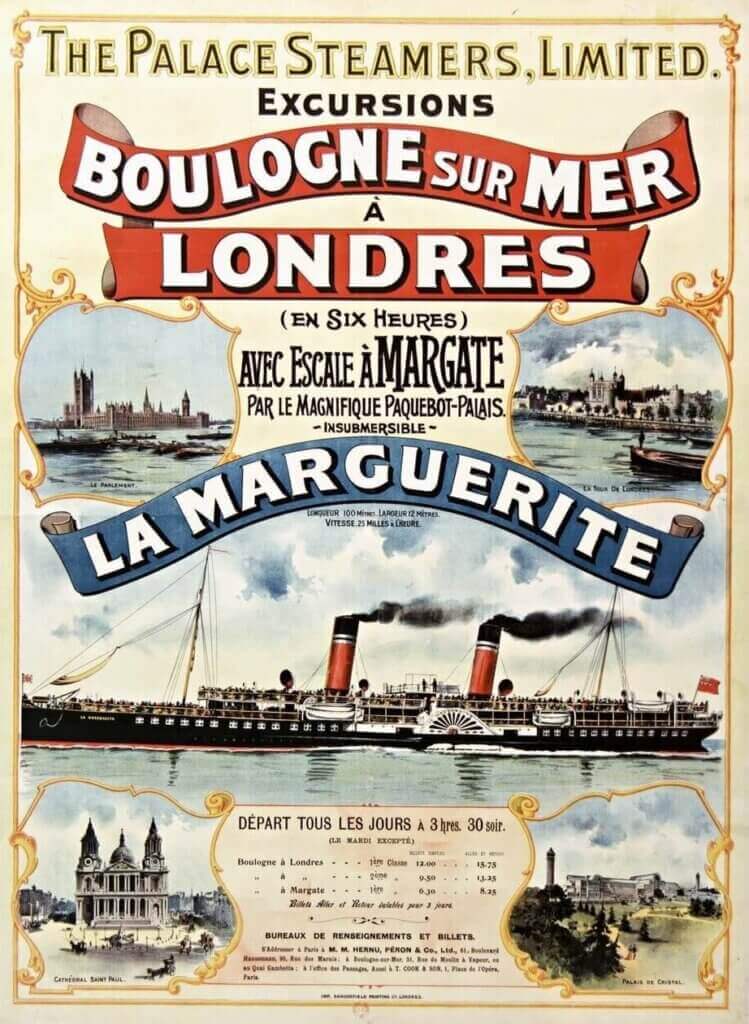
Colour lithograph travel poster from 1900 advertising steamship excursions between Boulogne-sur-Mer and London aboard “La Marguerite”. Image source: Bibliothèque nationale de France.
You may have a French record whose handwriting makes a name or place impossible to decipher. You may know that your ancestor came from a place in France, but be unable to find that place on a modern map. Perhaps the same name exists in several parts of the country, or the place mentioned in an old record is a hamlet, former commune or parish that no longer appears as a separate place.
These are common situations in French genealogy, particularly when researching from outside France. In this article, I describe some of the most common traps you may encounter when researching French places, and explain how you can work around them.
Trap 1 — The place was misheard, misspelled or mistranscribed
Of all the pitfalls in French family history research, this is the most common. Place names end up wrong for three main reasons.
The first pitfall lies with the ancestors themselves. When details were passed on verbally, what ended up on the record depended on how well they knew the spelling, which could be approximate.
The second source of error was the person who wrote the information down. Foreign officials and clerks sometimes knew little to nothing about French geography. They transcribed what they heard, applying the phonetic rules of their own language. “Bordeaux” became “Bordax”. “Roissy” became “Roicy”. Even “Toulon” turned into “Tulong”.
While some people may guess the real name easily, for those unfamiliar with France these small changes can have a significant impact, particularly when using search tools that rely on exact matches.
The third layer is online indexing. Although genealogy websites have made records much more accessible, they present the same problems. A place name that a human reader could work out may confuse a computer program or an indexer with limited knowledge of French history and geography.
What you can do
Focus on the person’s name first
Search by name and look for places that sound roughly like what you can read.
I once worked with a British family who had searched for years for an ancestor in the horse‑racing industry. He was born in France, but the place name was illegible on several documents. They believed he came from the south of France and had looked there.
Using his name and a precise birth date found in the English records, I located a promising birth entry. His military registration record gave an address in England.
His birth place turned out to be home to a stud farm with long‑standing English connections, and its census listed numerous jockeys and grooms. The man was from a tiny village in Burgundy, roughly 600 kilometres north of where the family had been looking.
Search by “Cluster”
If you find a partly correct place name, try to identify other people from the same record group who might have been relatives, and see where they were from. A different clerk may have spelled it correctly, or it may appear more clearly in a later record.
Type the illegible word into a search engine
Sometimes you get a plausible suggestions.
Use wildcard and fuzzy search tools
Most French genealogy databases allow wildcards. Use an asterisk (*) to search for multiple letters, or a question mark (?) for one letter. For example, searching for ‘Bo*d*x’ might catch ‘Bordeaux”. You can also search using only the first three or four letters. If available, you can also use a phonetic option.
Trap 2 – The place is not the right one
Before modern identity documents existed, details such as occupation, place of birth and place of death were recorded from information supplied by individuals or witnesses. When a person died in the place where they were born, this rarely caused problems, since the registrar and local community knew them. However, when someone from outside the area died far from home, the declarants usually knew little or nothing about the person’s background. Even close relatives might only have had partial information. Declarations were sometimes made by neighbours, landlords or employees who often knew even less. The result was often errors in place of birth, parentage or even surname, making the record unreliable or even misleading.
The most frequent culprit in this trap is ‘Paris’. I have come across many instances where the ancestor himself — or the family member reporting the event — gave ‘Paris’ as the place of birth or death, yet the person came from, or died in, somewhere else entirely. Perhaps the village was unknown outside its region, and ‘Paris’ was the French place least likely to be questioned. It was easy to say and spell, and it may have spared an ancestor the trouble of explaining an unfamiliar name to an immigration officer or census taker.
Naturalisation papers, census entries, newspaper obituaries and published death notices all demonstrate this shortcut. You will even find people recorded as having died in Paris on gravestones, even though they actually died in a neighbouring commune or somewhere entirely different.
Other major French cities occasionally served as convenient shorthand.
What you can do
Treat every place name as a working hypothesis
After an unsuccessful search, keep an open mind: the record may be associated with a different commune. Cross-reference between different record types. Until you have found the original record in a French archive, treat any place name — however official it looks — as something to be confirmed rather than trusted.
Take “Paris” with a pinch of salt.
Consider whether the event might have taken place in a neighbouring commune, such as Neuilly-sur-Seine, Saint-Cloud, Vincennes, or Levallois-Perret. These communes have their own civil-status records, held separately from those of Paris and searchable through the relevant archives.
Look for contradictions in the same record set
Compare multiple documents for the same person. A death certificate might say “born in Paris,” but a marriage record might name a small village. Trust the more detailed or locally sourced record over the vague one.
Trap 3 — The place no longer exists
Even if you have the correct spelling, the place you are looking for may not appear on a modern map because it no longer exists, or no longer exists under that name. France’s internal geography has shifted over the centuries, and in more ways than most people expect.
Merger
Several communes formed a new named entity
A village that appears in an 1880 birth record may today be a district of a larger town, or may have disappeared from administrative maps altogether.
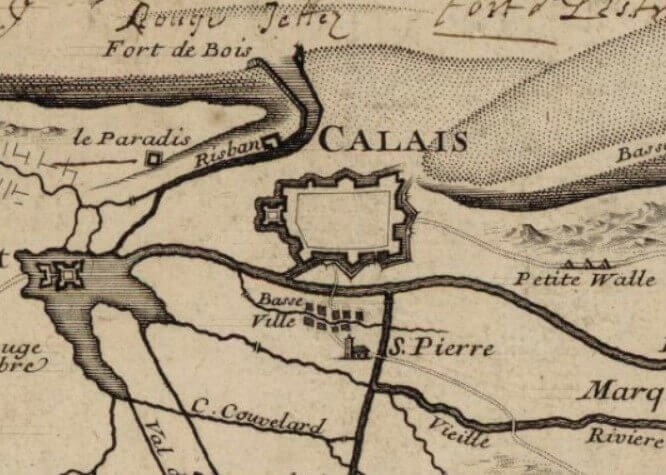
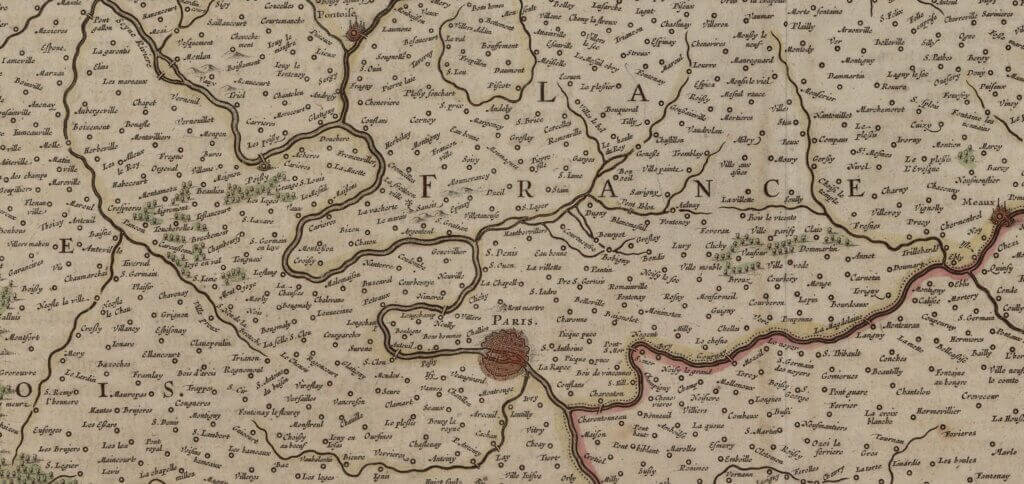
Detail from a 1709 map of the Calais region, showing settlements that later changed administrative status or disappeared as independent communes, including Saint-Pierre-lès-Calais.
Source: Bibliothèque nationale de France (Gallica)
Renaming
The commune exists but under a different name
During the Revolution, around 1,200 towns and villages were stripped of names considered too royalist or too religious. Port-Louis in Brittany, named after King Louis XIII, became Port-Liberté, before reverting to its original name in the early nineteenth century. Fewer than a hundred of those revolutionary names survived beyond that period.
The town now called La Roche-sur-Yon was founded in 1804 as “Napoléon”, renamed “Bourbon-Vendée” under the Restoration, then “Napoléon” again in 1848, before finally settling on “La Roche-sur-Yon” in 1870.
Illiers, a small town in Eure‑et‑Loir, was renamed Illiers‑Combray in 1971 in honour of Marcel Proust, who drew inspiration from the village when creating the fictional “Combray” in In Search of Lost Time. Châlons-sur-Marne became Châlons-en-Champagne in 1998.
Annexation
A small commune was merged into a larger one
If your ancestor was born in Bercy in 1854, you need to know that Bercy is no longer an independent commune. It was a separate village on the right bank of the Seine, famous for its wine warehouses, and has now been absorbed into the 12th arrondissement in the south‑east of the modern city.
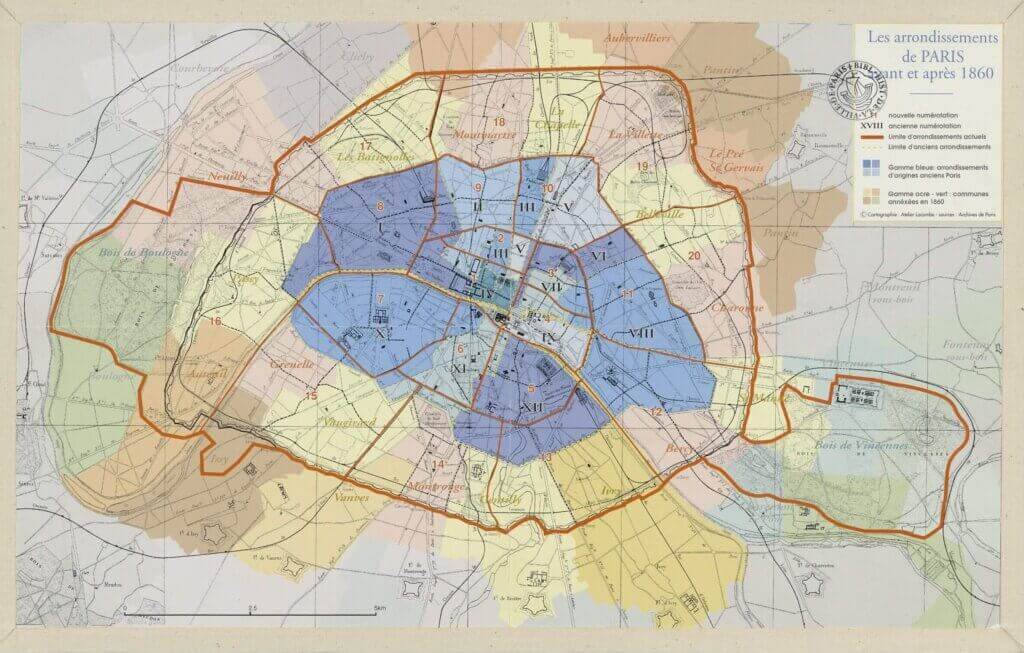
Map showing the expansion of Paris in 1860. The blue areas represent the former arrondissements of pre-1860 Paris, while the red boundary marks the enlarged city limits after the annexation of surrounding communes such as Belleville, Grenelle, Vaugirard and La Villette. Source: Bibliothèque Historique de la Ville de Paris (BHVP)
The places mentioned in your documents have their own histories, which cannot be fully captured in a single article. Name changes were rarely straightforward. Some communes changed their name, then reverted to the old one. Others kept an old name in daily use long after it had officially disappeared.
What you can do
Check online
I have not been able to find yet any online tool in English allowing you to look for this kind of information. Some Wikipedia pages have an English version. You can also use a search engine. For example, if you type “Charleville”, the suggested search term is instantly “Charleville-Mézières”.
Trap 4 — The name exists, but in different places
It is very common for locations to share the same name because they draw on the same sources: saints, waterways, ‘new towns’, aristocratic families or geographical characteristics. Dozens of places spread across completely different regions may have the same name.
Six towns in France have the name ‘Villeneuve’ (meaning ‘new town’).
The number grows considerably when variations are included: around 80 towns contain the name, such as Villeneuve-sur-Lot, Villeneuve-lès-Avignon and Villeneuve-Saint-Georges. This figure increases further if we include hamlets.
You might reasonably assume that anyone recording a place would include the full version. However, very often they did not, primarily because, to the person providing the information, there was only one Villeneuve: their own. Secondly, perhaps in their time, the name of their place was simply ‘Villeneuve’.
Common geographical descriptors are just as widespread. There are many communes called Saint-Martin, Saint-Jean, Saint-Pierre, La Chapelle, Beaumont, Montfort, Bellevue, Bois…. Each of these roots generates dozens of places in multiple regions.
What you can do
Cross-reference with known family locations
If you have other records from other relatives pointing to a specific region – say, Lot-et-Garonne – then “Villeneuve” likely means Villeneuve-sur-Lot. If they lived near Paris, it might be Villeneuve-Saint-Georges or Villeneuve-la-Garenne.
Search for the same surname in each candidate commune
Pick the top three or four candidate communes. Search each one’s civil registration or parish records for the ancestor’s surname around the event date. The commune that yields matches (witnesses, spouses, neighbours with the same surname) is highly likely to be the correct one.
Trap 5 — Your ancestor may not have been French
Not every French-sounding ancestor was French. This trap is subtler than the others, but it can send an entire line of research into the wrong country’s archives.
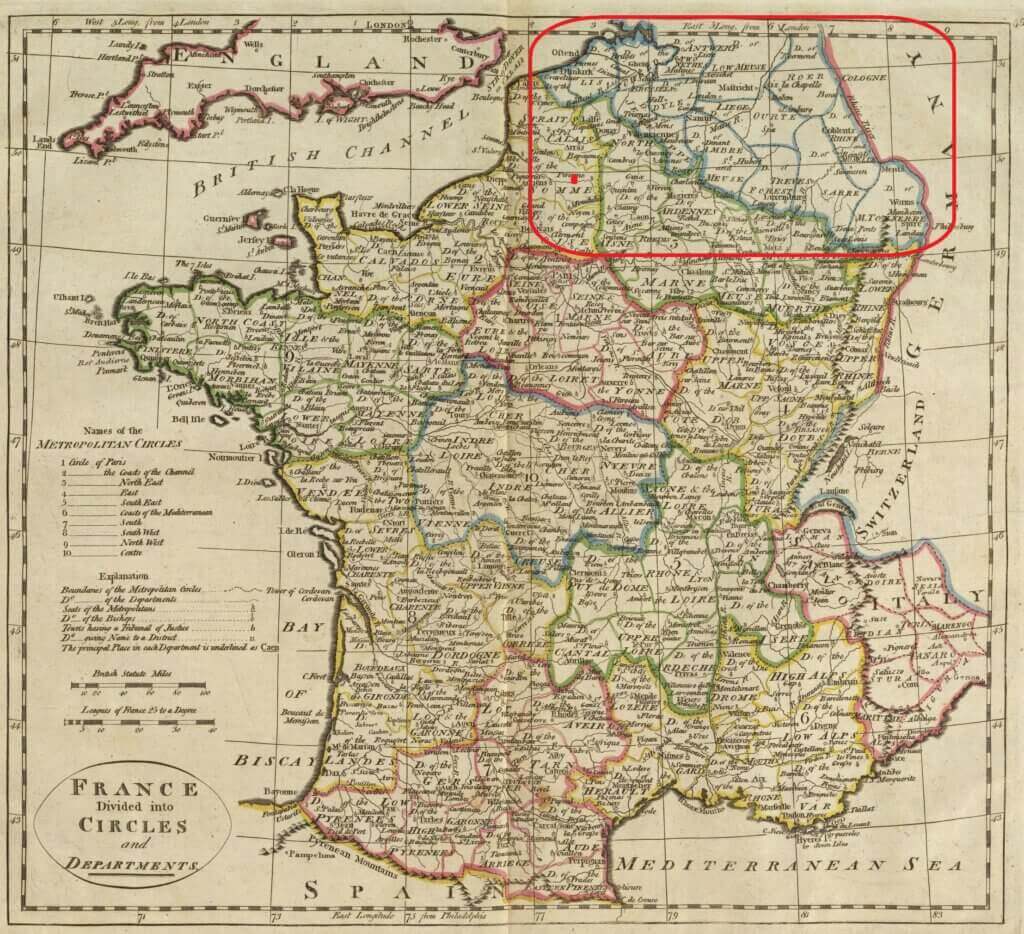
France Divided into Circles and Departments by Mathew Carey (1814), showing France during the final years of the Napoleonic Empire, when present-day Belgium formed part of French territory. Source: David Rumsey Map Collection.
A Frenchman … or a Belgian ?
Fans of Agatha Christie will remember that Hercule Poirot was forever being mistaken for a Frenchman. He was, of course, Belgian — and took considerable offence at the confusion. The mistake was understandable: he spoke French, bore a French‑sounding name, and the cultural boundary between the two countries was not always obvious to an outsider.
The history of Belgium is actually quite complex, and a few lines cannot do it justice. That said, one important detail is that Belgium was annexed by France in 1795 and remained under French rule until 1814.
The region was integrated directly into the French Republic. It was divided into nine departments. Because the territory was legally part of France, the inhabitants became French citizens. A person born in Ghent in 1805 was therefore born French; if they emigrated later, they may have described themselves as Belgian (after Belgium became independent in 1830), or the record might label them French simply because they were born under French rule.
Quite apart from this shared history, Belgians often appear in foreign records as ‘French’, even though their birth records are held in Belgium and they held Belgian nationality.
The word ‘French’ on a document is no guarantee that the person was born within France’s modern borders. Assuming so can sell both your research and your ancestor’s actual identity short.
German by Record, French by Birth
You find a record describing your ancestor as German. Before you conclude that your French research has gone astray, consider where in “Germany” they might have come from.
The historical region of Alsace‑Lorraine lies in what is now north‑eastern France. It borders Germany to the east, Switzerland to the south, and Luxembourg to the north. Its principal cities include Strasbourg, Metz, Colmar, and Mulhouse.
After the Franco‑Prussian War of 1870 – 1871 (Prussia being the kingdom that led the German states), the region was annexed by the newly created German Empire.
Under the Treaty of Frankfurt, France was forced to cede a vast territory of 14,522 square kilometres. It comprised 1,705 communes with a population of roughly 1.9 million inhabitants. This encompassed almost the entire former départements of Bas‑Rhin and Haut‑Rhin, along with a large portion of Moselle.
It remained under German administration until 1918, and was occupied again between 1940 and 1945.
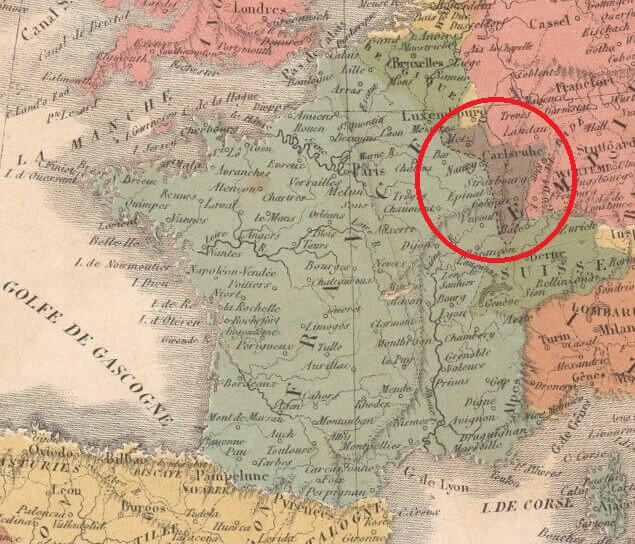
Detail from Théodore Lefèvre’s 1871 map “Nouvelle carte d’Europe avec toutes les dernières annexions”, showing Alsace-Lorraine.
Today the area corresponds roughly to the French départements of Bas‑Rhin, Haut‑Rhin, and Moselle, which together form part of the Grand Est administrative region.
Someone born in Strasbourg in 1860 could have been born French, lived most of their life as German, and died French again.
In this area, civil records were kept in German, under German administrative rules. Because the region was returned to France after the First World War, those registers from the German period stayed in place and are now available for consultation in French public archives.
What you can do
Search the full name
In most cases like this you can possibly find a second document (for example, a naturalisation paper) that gives the correct place. Check the date of the event against border changes.
Use tools that aggregate results
Tools, like Filae, that aggregate results from several countries can show you if a surname is overwhelmingly present in Belgium.
If an ancestor is recorded as German and the records do not add up, consider Alsace-Lorraine — and pay close attention to whether they left before or after 1871
Conclusion
The traps described here are the ones I encounter most regularly in my work with English-speaking clients tracing French ancestry. They are not exhaustive — French genealogy always holds surprises — but they cover the situations most likely to bring a search to a halt.
Be especially careful with common names. Surnames such as Moreau, Bernard, Martin or Petit, and given names like Jean, Jeanne, François or Françoise, appear in almost every town and every generation. A name match alone proves nothing. The parents’ names, ages, locations and occupations all need to be checked before you can be confident you have the right person in the right place.
The good news is that French civil records are exceptionally well kept and are being digitised at an impressive pace. Once you identify the correct place, the research almost always becomes much easier.